
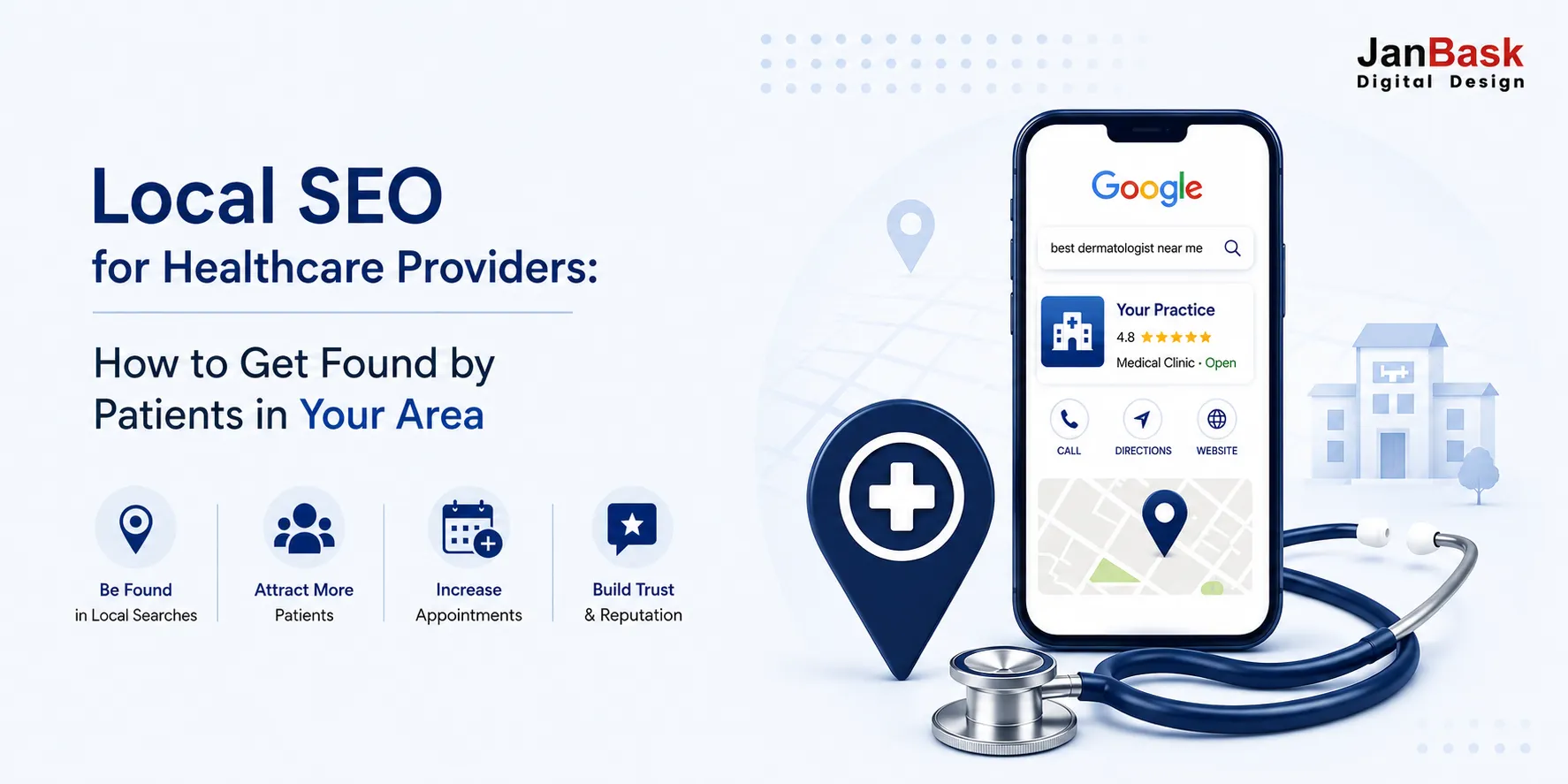
Local SEO for Healthcare Providers: How to Get Found by Patients in Your Area
Every day, thousands of people in your city open Google and search for a doctor, a clinic, or a specialist. They type in something like "best dermatologist near me" or "urgent care open now," and they book with whoever shows up first. Not necessarily the best provider in town. Just the one who shows up first.
That's the reality of local SEO for healthcare providers in 2026. According to research cited by the National Institutes of Health, nearly 77% of patients now begin their care journey online. In 2023, online search officially overtook physician referrals as the leading way Americans find new doctors. The window between a patient searching and a patient booking is shorter than it's ever been.
That's where local SEO comes in. Done right, local SEO for healthcare providers puts your practice in front of the right patients at the exact moment they're ready to book. In this guide, you'll learn how to optimize every part of your local presence from your Google Business Profile to your keywords, location pages, patient reviews, and the technical details that most practices completely miss.
Here's what we'll cover:
- What local SEO actually means for healthcare providers
- Why 2026 has changed the rules
- How to get your Google Business Profile working for you
- Keyword strategy that goes beyond the obvious
- Building location and service pages that rank
- NAP consistency and citation management
- Getting patient reviews the right way (without touching HIPAA)
- Schema markup: the technical edge most competitors ignore
- Mobile and page speed: why it matters more than ever
- How to track whether any of this is actually working
Let's get into it.
What Is Local SEO for Healthcare Providers?
Local SEO is the process of making your practice visible when people nearby search for the care you offer. It's not about ranking nationally. It's about showing up in your city, your neighborhood, your zip code.
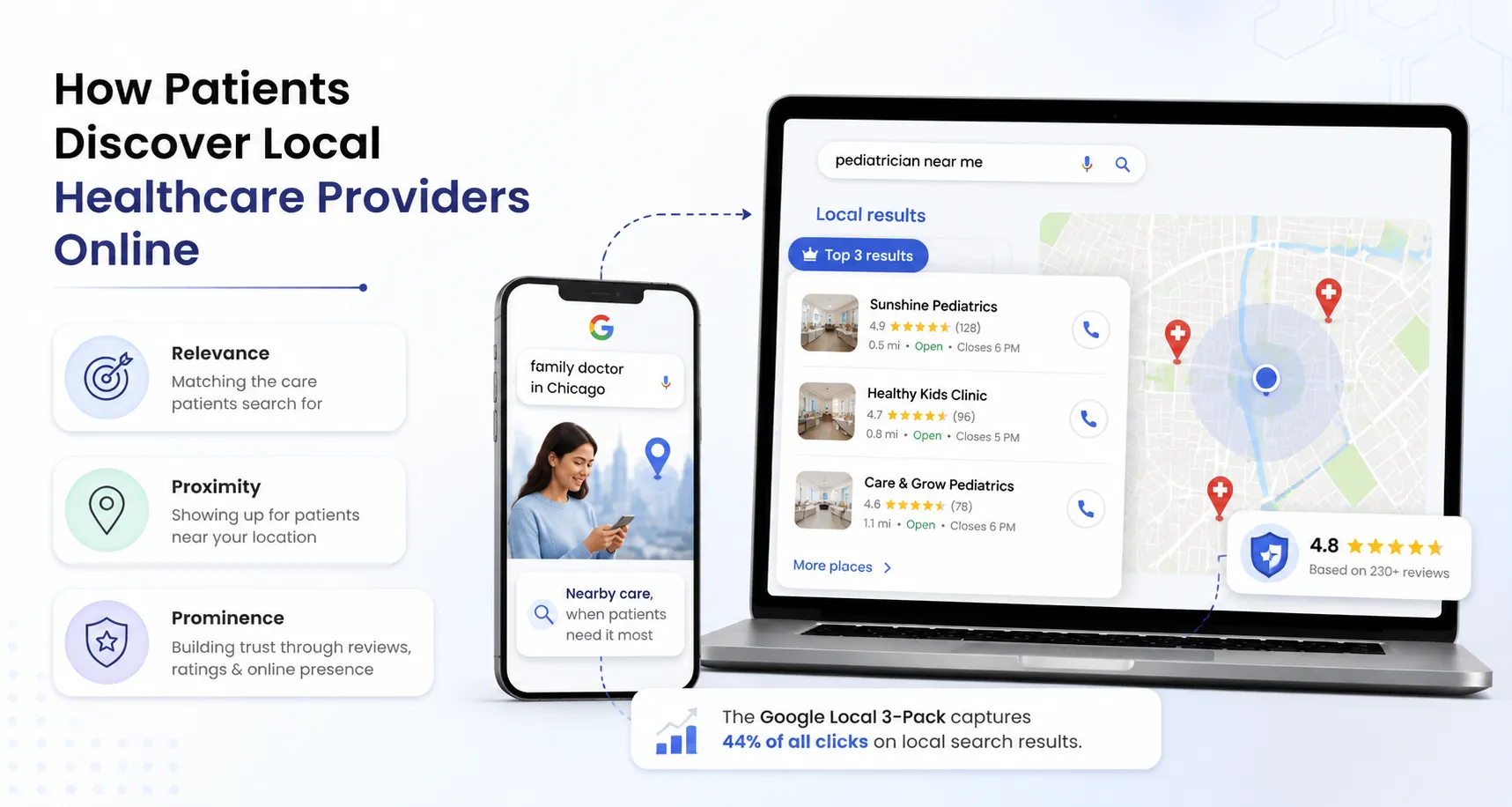
When someone searches "family doctor in Chicago" or "pediatrician near me," Google looks at three things: how relevant your practice is to what they searched, how close you are to where they're searching from, and how trustworthy your online presence is. Those three factors relevance, proximity, and prominence are what local SEO is built around.
The most visible payoff of getting this right is landing in the Google Local 3-Pack: the map-based block of three results that appears at the very top of the search page. Research shows the 3-Pack captures roughly 32% of all clicks on a local search results page. For healthcare providers, that's where patients decide who to call.
General SEO gets you found. Local SEO gets you chosen.
How Google Local Search Changed for Healthcare SEO in 2026
The fundamentals of local SEO haven't changed but the competitive environment has intensified in two important ways.
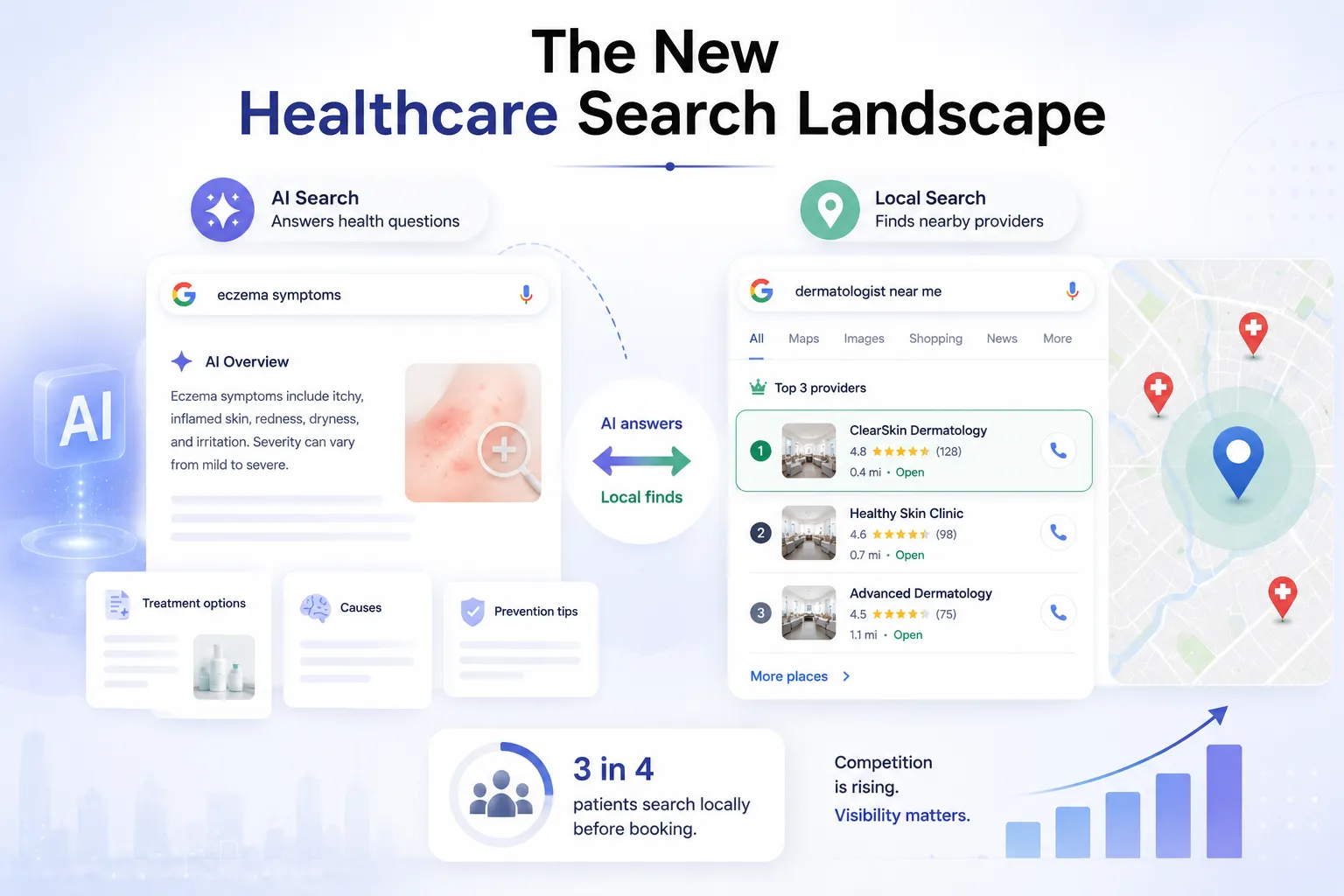
The AI Overviews split. Google now displays AI-generated summaries for many health-related searches, but recent research by BrightEdge confirms something important: as of December 2025, Google removed AI Overviews entirely from local provider intent queries. Searches like "dermatologist near me," "cardiologist near me," and "pediatric dentist near me" now return traditional local results map packs, organic listings, and Google Business Profiles. For your new patient acquisition, this is actually good news. The queries that drive bookings are still firmly in traditional SEO territory.
Where AI Overviews do appear is on clinical information queries symptoms, conditions, treatments. If you produce educational content on those topics, structuring it with proper headings, FAQ sections, and E-E-A-T signals (more on this below) will help you show up in those AI summaries.
The search volume surge. Roughly 3 in 4 patients now look for providers on Google Maps or local search before booking an appointment. Competition for those top positions has increased significantly across almost every specialty and market. The practices winning local SEO today aren't necessarily the best clinicians in their area, they're the ones who treat their digital presence like infrastructure. If you want to understand how local SEO fits into your broader growth strategy, our healthcare marketing strategies guide is a good place to see the full picture.
Google Business Profile Optimization for Healthcare Providers
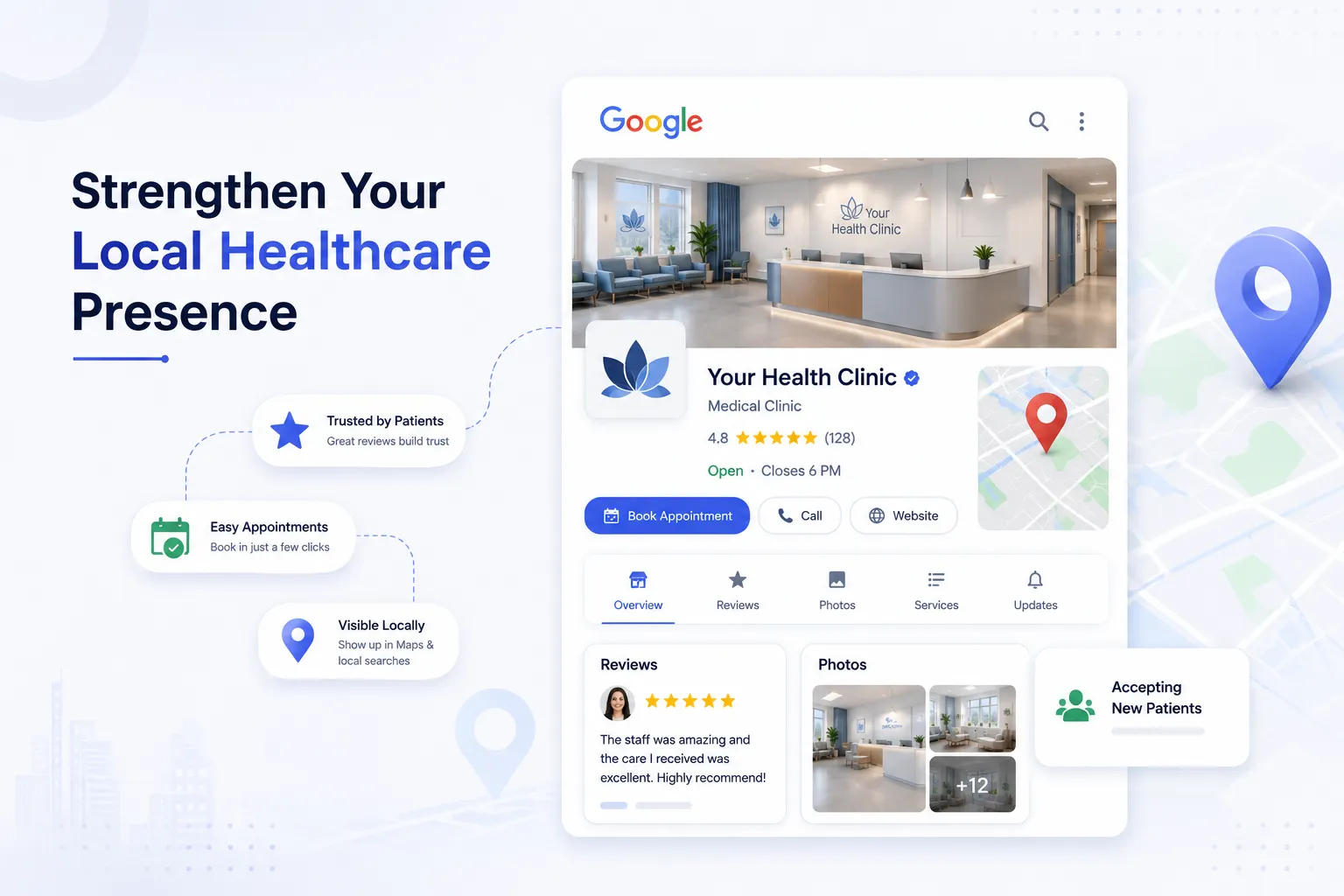
If there's one thing you do after reading this article, make it this: get your Google Business Profile (GBP) in order. It's the single most powerful tool you have for local SEO, and it's free.
Your GBP is what drives your appearance in the Google Local 3-Pack, Google Maps, and the knowledge panel that shows up when someone searches your practice name directly. An incomplete or neglected profile tells Google and patients that you're not paying attention.
Start with the basics. Your practice name, address, phone number, and hours need to be accurate and complete. Add your website URL, enable the appointment booking link, and select the most specific category that matches your specialty. A general internist and a sports medicine physician aren't the same category, and Google treats them differently.
Then go further. Uploading real photos of your clinic, team, and waiting are practices with photos that receive 42% more direction requests and 35% more website clicks, according to Google's own data. Enable the Q&A feature and seed it with answers to the questions your front desk gets every day: "Do you accept walk-ins?" "Are you taking new patients?" "Do you accept Medicare?" Patients searching on mobile want these answers fast, and your GBP is where they look.
Post regular updates. A new provider joining the team, a seasonal flu shot reminder, an updated holiday schedule these signals tell Google your profile is active. Practices with regularly updated GBPs consistently outperform static ones.
Your GBP isn't a one-time setup. It's a living asset that needs consistent attention to keep working for you. If you want a step-by-step walkthrough, our Google Business Profile optimization guide for healthcare practices covers every setting in detail.
Local SEO Keyword Strategy for Healthcare Providers.
Most healthcare providers think about keywords in the most obvious way: "doctor in [city]" or "clinic near me." Those matter, but they're also the most competitive. The practices that win local SEO go a layer deeper.
There are three keyword types that should shape your strategy.
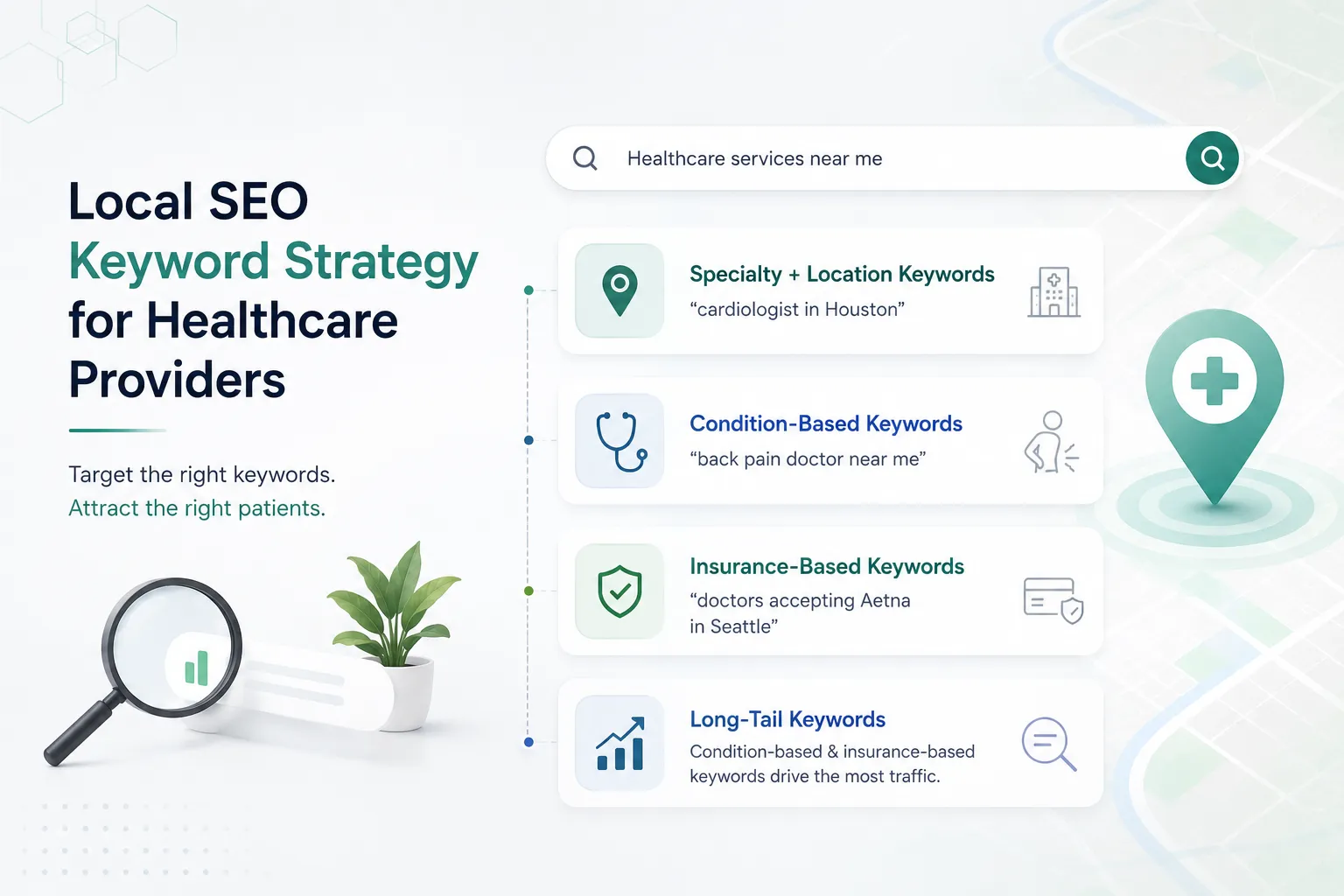
Specialty + location keywords.
These are straightforward: "cardiologist in Houston" or "pediatrician in Brooklyn." Every core page on your website should be built around one of these. They tell Google exactly who you are and where you serve.
Condition-based keywords
Patients don't always search by specialty, they search by problem. "Back pain doctor near me" or "anxiety treatment clinic in Denver" are how people look for care when they already know what's wrong. These convert well because the patient has already self-identified their need.
Insurance-based keywords.
This is the most overlooked opportunity in healthcare SEO. Searches like "doctors accepting Aetna in Seattle" or "Medicare-accepted clinic near me" are high-intent, surprisingly low-competition, and almost entirely ignored by most practices. Dedicated pages targeting these terms can quietly become some of your highest-performing local pages. If you accept a wide range of insurance plans, each one is a potential keyword opportunity.
Long-tail keywords:
the condition-based and insurance-based ones drive the majority of search traffic. For healthcare providers doing local SEO, that's not a small opportunity. That's where most of your patients are searching. Our comprehensive SEO for healthcare guide goes deeper on keyword research and content strategy if you want to build this out further.
Building Local SEO Service Pages for Healthcare Providers
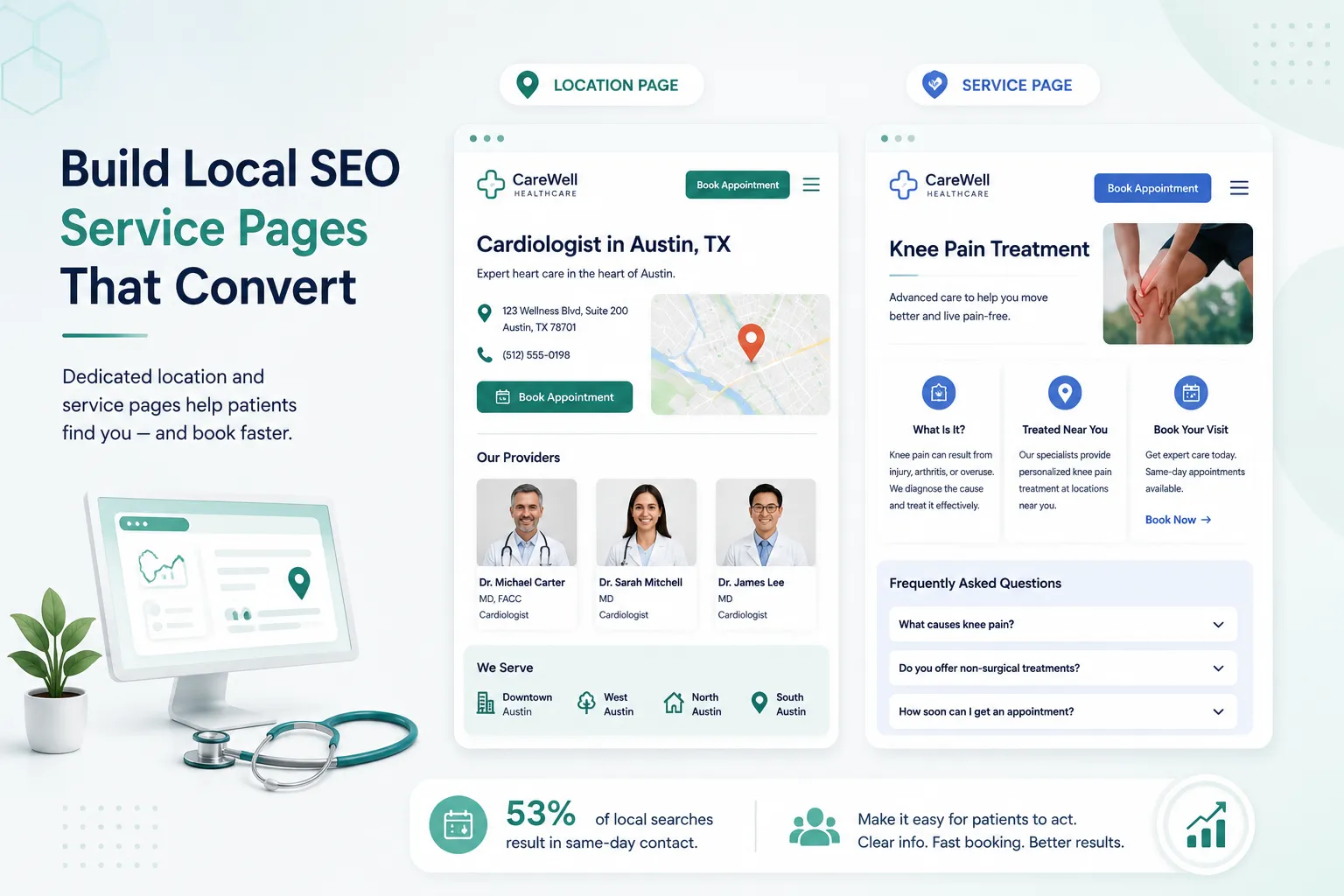
Your homepage can't do all the heavy lifting. If you want to rank for multiple locations or multiple services, you need dedicated pages for each and each needs to be built with local search in mind.
For location pages
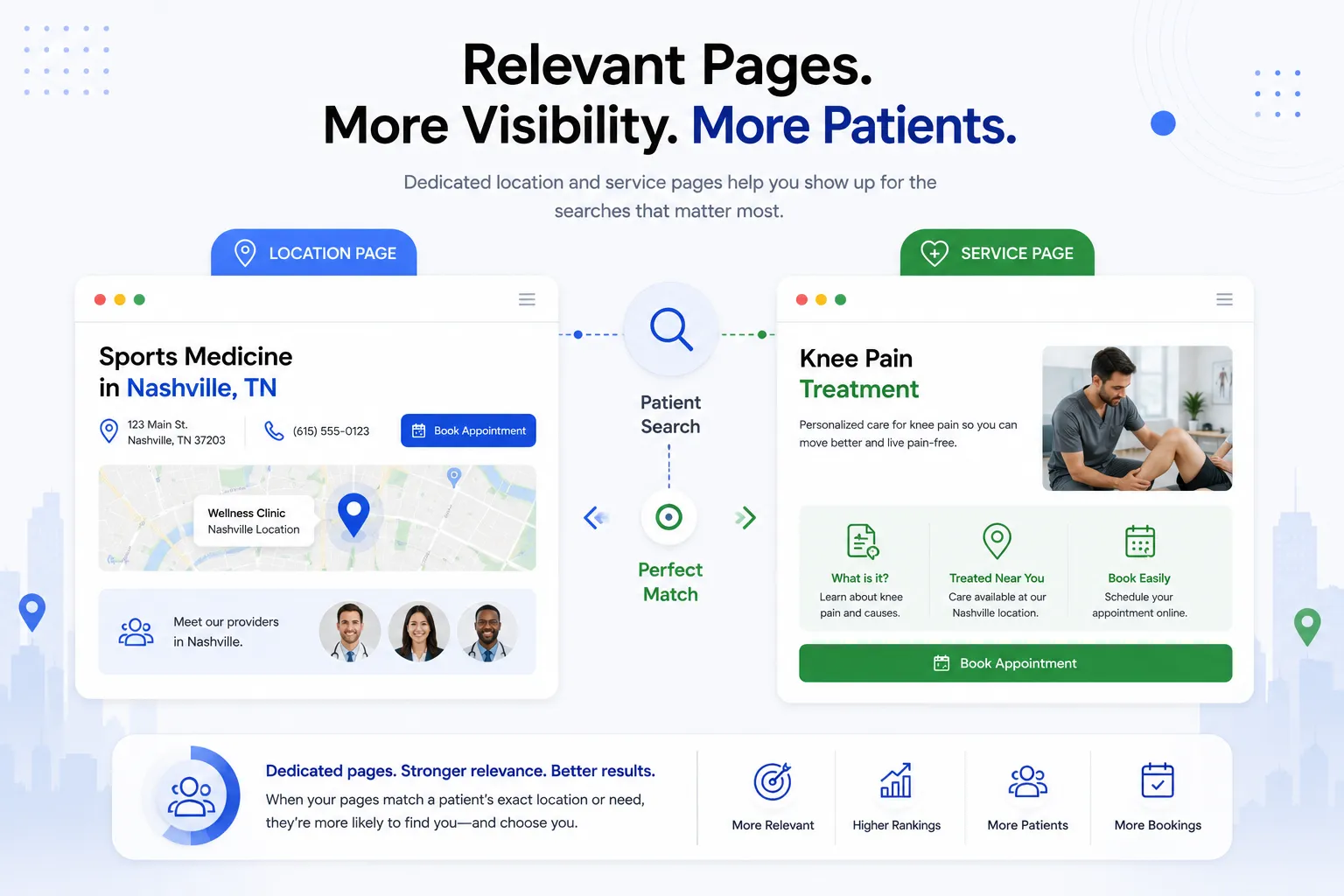
every page should include the local keyword in the title and the first paragraph, the full address with an embedded Google Map, your phone number, and a clear button to book an appointment. List your providers at that location by name, with photos and brief bios — Google values that specificity, and so do patients. If you have multiple locations, don't copy-paste the same content with only the city name swapped. Google can identify thin or duplicate pages and will penalize them. Each location page should reflect what's genuinely distinct about that location: the providers there, the services offered, the neighborhoods served.
For service pages
build one page per core service. A standalone page for "knee pain treatment" will always outrank a generic "what we treat" page that mentions knee pain in passing. Each service page should answer the three questions your patient is already asking: What is this condition or service? Do you treat it near me? How do I book?
Add an FAQ section at the bottom of each location and service page. Not only does this help patients, but FAQ schema (more on this below) can get those questions displayed directly in search results, increasing your click-through rate significantly. If you're not sure where to start, our healthcare website design service page walks through exactly what a well-structured local page needs to include.
Research shows that 53% of local searches result in same-day contact. The patient landing on your location or service page is often ready to act immediately. Give them every reason and every easy path to do so.
NAP Consistency and Local Citations
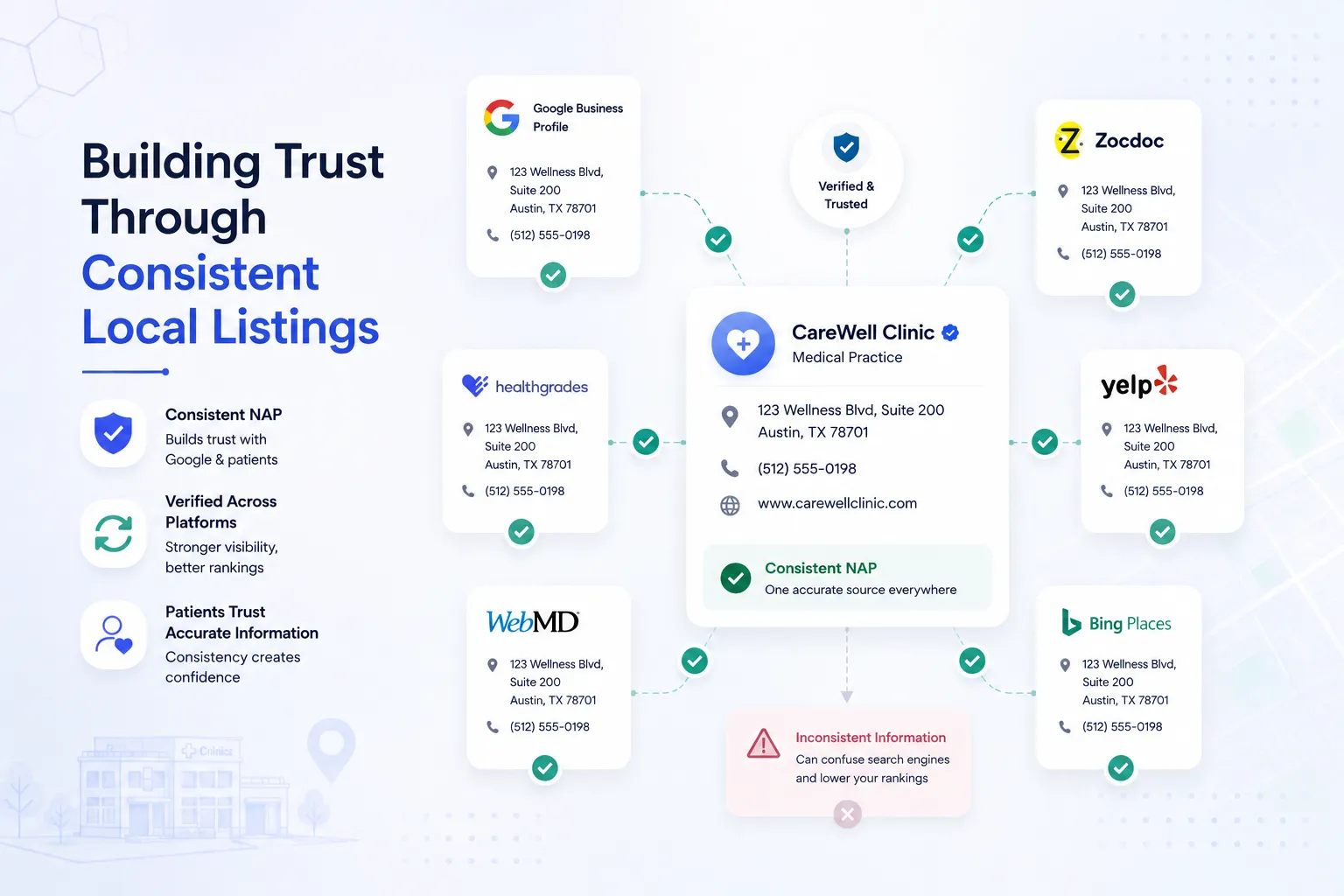
NAP Name, Address, and Phone number needs to match exactly everywhere your practice appears online. Not roughly. Not close enough. Exactly.
Here's why: when Google finds your practice listed on Healthgrades, Zocdoc, Yelp, and WebMD, it cross-references those listings against each other to verify you're a legitimate, established business. If your address shows "Suite 200" on your website but "Ste. 200" on Yelp, Google can treat those as two different entities. That inconsistency slowly erodes your local rankings.
The healthcare directories that matter most are Google Business Profile, Healthgrades, Zocdoc, WebMD, Vitals, Yelp, and Bing Places. Start there before expanding to smaller directories. Beyond directories, also check data aggregators companies like Data Axle and Neustar that automatically syndicate your business information to hundreds of platforms. If your data is wrong at the aggregator level, it can spread incorrect NAP information across the web faster than you can manually fix it.
Research consistently shows that incorrect or inconsistent online information causes patients to lose trust in a local business. In healthcare, that trust hit is amplified; patients expect clinical precision, and sloppy directory listings undermine that expectation before they've ever walked through your door.
When you move locations, change your phone number, or add a new office, update every listing immediately. Don't let it slip.
How Patient Reviews Improve Local SEO for Healthcare Providers
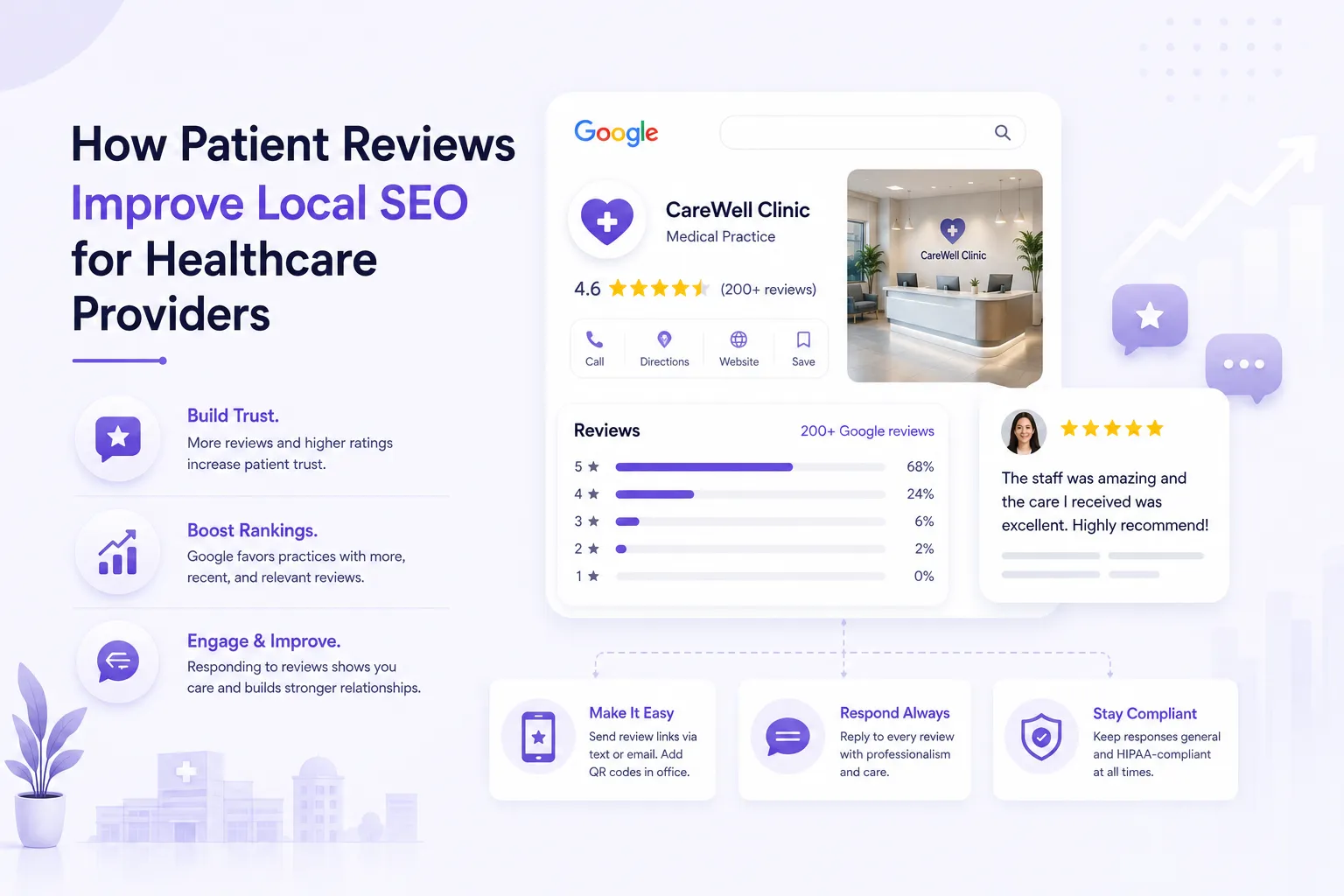
Reviews are not just a trust signal, they're a direct local ranking factor. Google looks at how many reviews you have, how recent they are, and how you respond to them. A practice with 200 reviews and a 4.6-star average will almost always outrank one with 20 reviews and a perfect 5.0, because volume and recency signal activity.
Research from 2026 shows that more than 94% of patients read reviews before booking, and 84% won't consider a provider rated below four stars. Those numbers are higher than virtually any other service industry.
Asking for reviews in healthcare requires care.
You can't incentivize them, you can't pre-screen patients before asking, and critically, you cannot reference any patient details in your responses. Saying something as simple as "glad we could help with your back pain" in a reply is a potential HIPAA violation. Keep responses warm but general: "Thank you for sharing your experience. We're glad to hear your visit went well." For more on what's allowed, see our guide to HIPAA-compliant healthcare websites and marketing practices.
To generate reviews consistently, keep the process simple: send a post-visit text or email with a direct link to your Google review page, place a QR code in your waiting room, and train your front desk to mention it naturally at checkout. These small habits compound over time.
Respond to every review
positive and negative. A calm, solution-focused response to a critical review signals professionalism and care to every future patient reading it. If a review is factually false or violates Google's policies, you can flag it for removal, document the case clearly and report it through Google Business Profile.
Also pay attention to reviews on Healthgrades, Zocdoc, and Vitals. These platform-specific ratings carry real weight when patients are evaluating clinical credibility, separate from the Google reviews that drive search rankings.
Schema Markup for Healthcare Local SEO: The Technical Edge Most Practices Miss
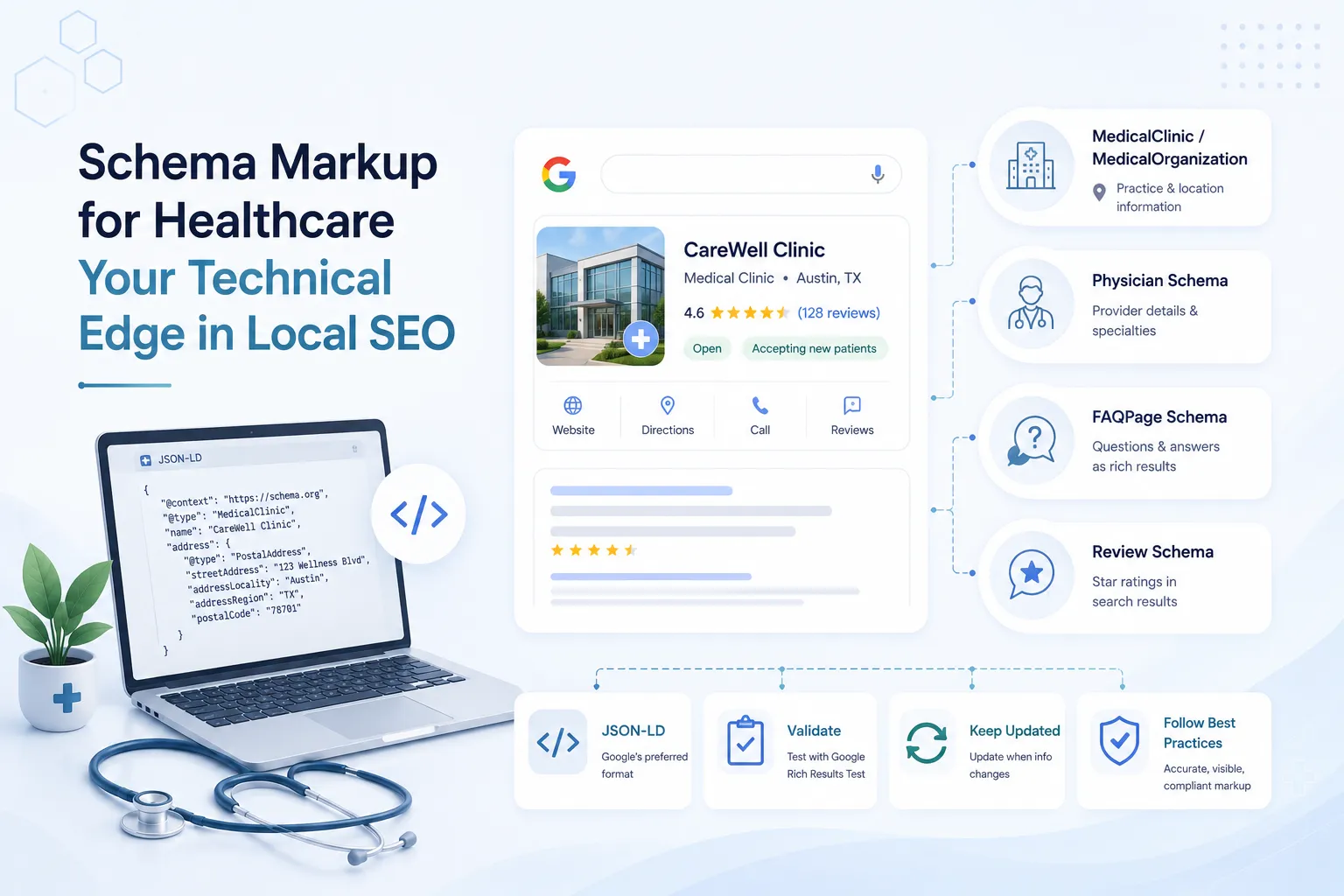
Schema markup is structured data you add to your website to help Google understand exactly what your practice is, where it is, and who it serves. Think of it as a translation layer that takes information that's obvious to human visitors and makes it machine-readable for search engines and AI systems.
Most healthcare websites don't have it, which means implementing it correctly gives you a real competitive advantage. For a deeper walkthrough of how to set this up step by step, see our complete schema markup guide for healthcare websites.
The schema types that actually matter for healthcare practices are:
- MedicalClinic or MedicalOrganization on your homepage and location pages this tells Google you're a healthcare practice with a physical location and feeds your local knowledge panel, Google Maps, and AI-driven local search features.
- Physician schema on provider profile pages allows search engines to display credentials, specialties, and whether a doctor is accepting new patients directly in search results, reducing calls and increasing appointment requests.
- FAQPage schema on service pages, location pages, and your FAQ section enables your questions and answers to appear directly in search results as expandable rich results, meaningfully increasing click-through rates.
- Review schema on any page where you host patient testimonials can surface your star ratings directly in search results, which builds trust before the patient even clicks.
Implement all schema in JSON-LD format, which is Google's preferred format and doesn't interfere with your page content. Once implemented, validate it with Google's Rich Results Test to confirm it's registering correctly. Keep it updated if you move locations, change hours, or add a provider, update the schema to match.
A few things to avoid: don't mark up information that isn't visible on the page, don't use medical condition or treatment schema types to pad your markup (these don't produce rich results and Google ignores them), and make sure any review schema only covers reviews you host on your own site, not external reviews from third-party platforms.
Mobile Speed and Technical SEO for Healthcare Websites
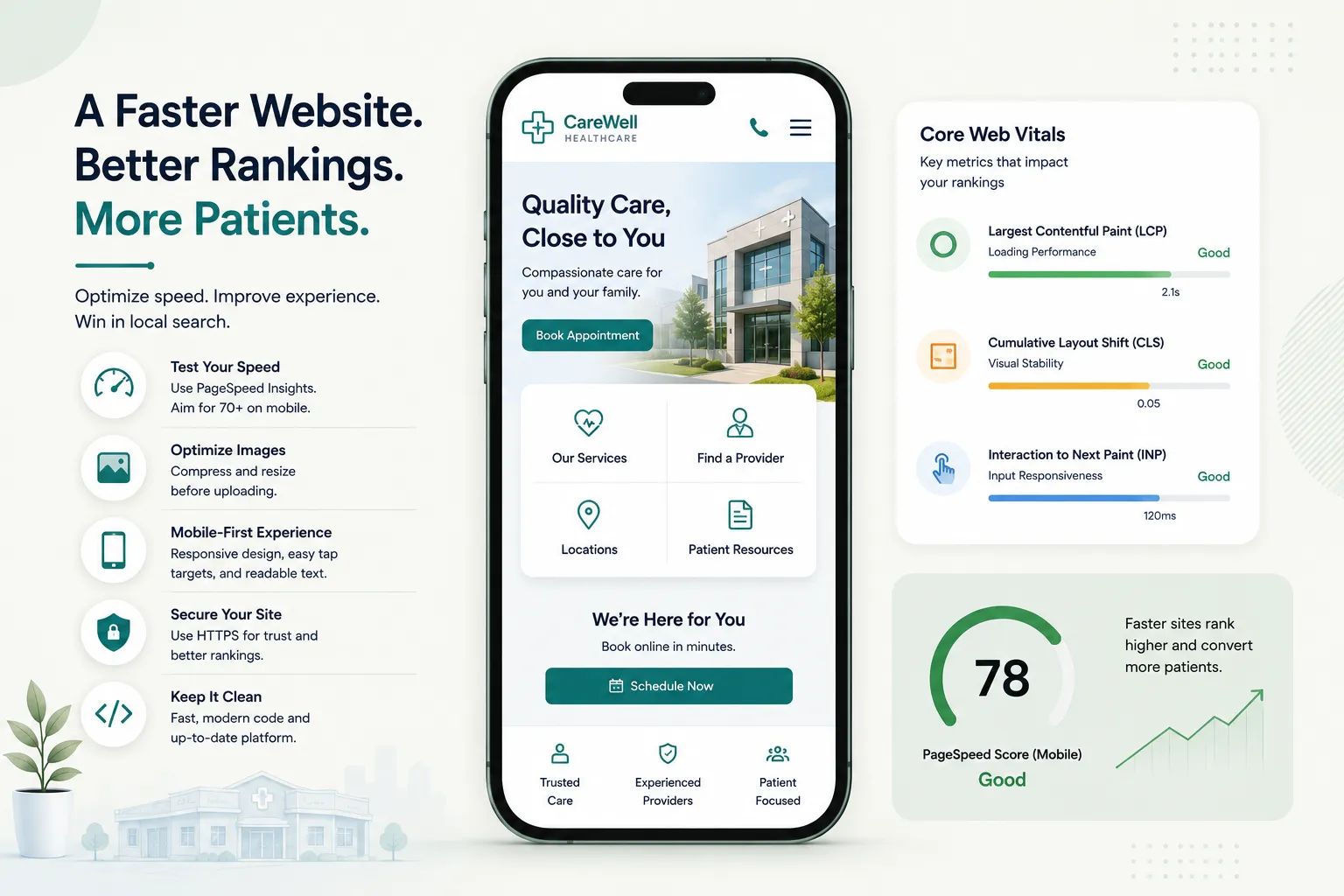
This one gets skipped more than any other section in healthcare SEO articles, but it directly impacts your local rankings and your patient conversion rate. A slow, unoptimized website undermines every other local SEO effort you make.
The majority of healthcare searches now originate from mobile devices. Patients searching "urgent care open now" at 8pm on a Saturday are on their phones. If your website takes more than three seconds to load on mobile, a large share of those patients will leave before the page finishes loading.
Google's Core Web Vitals, a set of performance metrics measuring loading speed, visual stability, and input responsiveness are a confirmed ranking factor. Practices on slow or unoptimized websites are at a structural disadvantage against competitors with faster, better-built sites, even when all other local SEO factors are equal.
Here's what to check and fix:
- Run your site through Google PageSpeed Insights (pagespeed.web.dev). Aim for a score above 70 on mobile. Below 50 is a significant problem.
- Compress and resize images before uploading. Large image files are the most common reason healthcare sites load slowly.
- Make sure your site is mobile-responsive — buttons should be large enough to tap, text should be readable without zooming, and your booking form should work cleanly on a small screen.
- Check that your site runs on HTTPS, not HTTP. Google treats non-secure sites as a trust issue, and patients will see a browser warning before they even reach your content.
If your current website is built on an outdated platform or hasn't been technically reviewed in the past two years, page speed and mobile performance are worth auditing before you invest more in content or citation building. Staying current with what a modern, high-performing healthcare site looks like, from layout to load time, is something our healthcare website design team works on daily. All the local SEO work in the world underperforms on a slow foundation.
How to Track Whether Your Local SEO for Healthcare Is Working
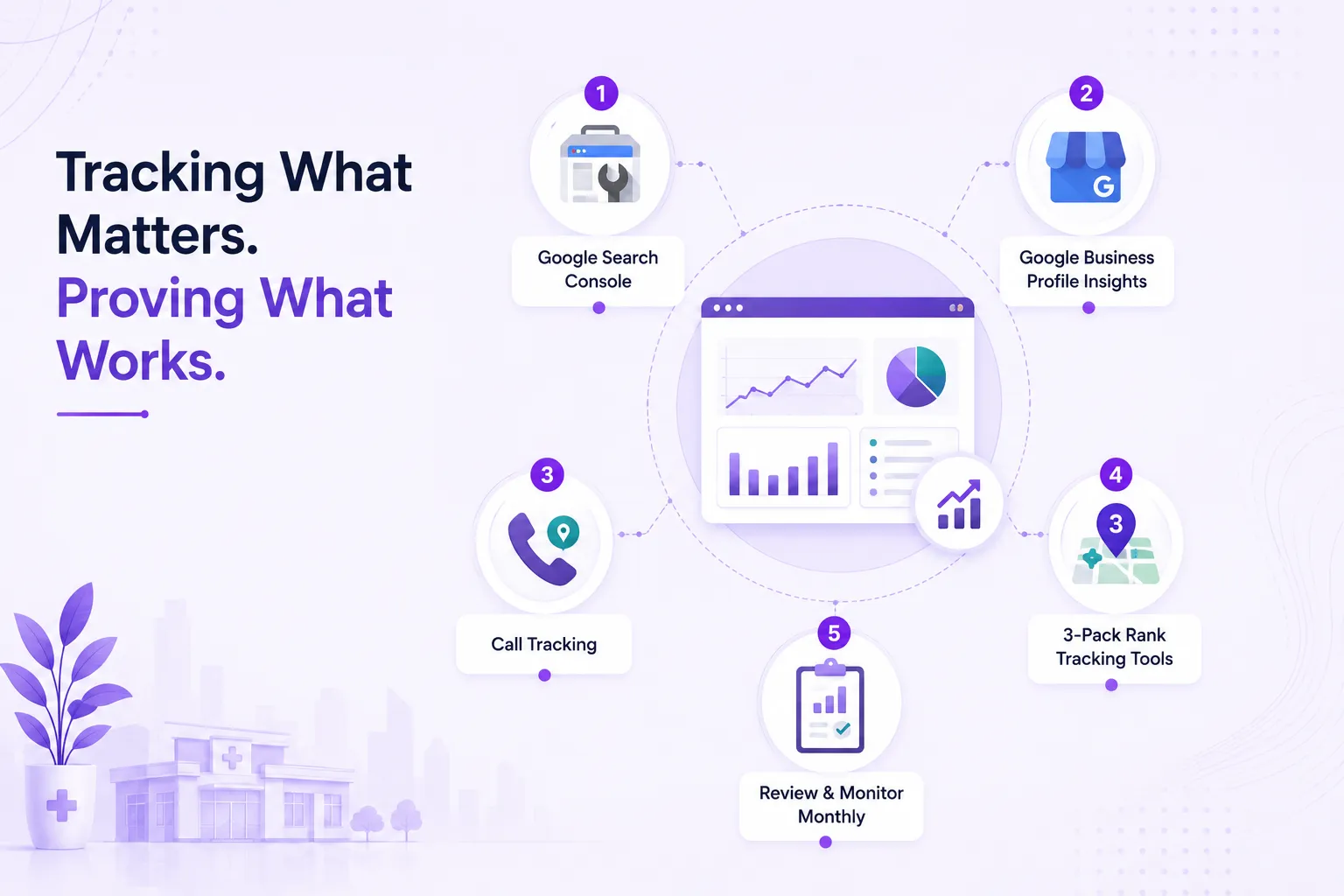
A lot of healthcare providers invest in local SEO and have no idea if it's doing anything. That's a solvable problem. You don't need a complicated analytics setup; three tools will tell you most of what you need to know.
Google Search Console shows you which keywords are bringing patients to your website, how often your pages appear in search results, and which pages are getting the most clicks. If you launched a new location page last month, this is where you'll see it start gaining traction. Check it once a month.
Google Business Profile Insights shows you how patients are finding and interacting with your profile, specifically how many searched for you directly, how many found you through a category search, how many clicked for directions, and how many called you straight from the listing. These numbers tell you whether your GBP is actively driving patient actions or just sitting idle.
Call tracking closes the final loop. Tools like CallRail let you assign a unique phone number to your local SEO efforts so you can see exactly how many calls and ultimately how many appointments are coming directly from search. This turns local SEO from a vague marketing activity into a measurable business driver.
For monitoring your position in the 3-Pack specifically, tools like BrightLocal and Whitespark let you track your local pack rankings across keywords over time. This is especially useful if you're in a competitive market and want to see whether your rankings are improving, holding, or slipping.
Review your numbers monthly. Consistent tracking is what separates practices that grow predictably from practices that guess and hope. If you want help interpreting your data and connecting it to patient acquisition, our healthcare SEO service includes monthly reporting and rank tracking built for clinical practices.
A Quick-Start Checklist
Not sure where to begin? Here's the order that gives you the fastest return:
- Claim and complete your Google Business Profile : Name, address, phone, hours, photos, booking link, Q&A
- Audit your NAP : Across Healthgrades, Zocdoc, WebMD, Yelp, Vitals, and Bing Places
- Build one location page: for your primary location with the full address, embedded map, and a booking button
- Add MedicalClinic + FAQPage schema: to your homepage and top service pages
- Run a mobile speed test: via Google PageSpeed Insights and fix the top issues
- Set up a post-visit review request: a simple text or email with a direct GBP review link
- Connect Google Search Console: and check which pages are already getting traction
- Build your first condition-based service page: targeting a high-volume patient problem in your specialty
Do these eight things consistently, and you'll be ahead of the majority of your local competitors within 90 days.
Final Thoughts on Local SEO for Healthcare Providers
Local SEO for healthcare providers isn't a one-time project. It's an ongoing commitment to showing up for patients at the exact moment they need you. Every optimized page, every consistent listing, every review you respond to, every piece of schema you add compounds into a practice that Google trusts and patients choose.
The healthcare providers winning in local search right now aren't necessarily the best in their field. They're the ones who made it easy to be found.
If your current website isn't built to support these strategies, fast, mobile-friendly, and technically structured the way Google expects, that's the place to start. A site that can't perform technically will hold back everything else you do in local SEO. Our healthcare website design service is built specifically for practices that need to rank locally, convert visitors, and stay compliant.
Start with one section from this guide today. Fix your GBP, audit your NAP, or build that first location page. Small, consistent steps are what separate practices that grow from practices that stay invisible.