
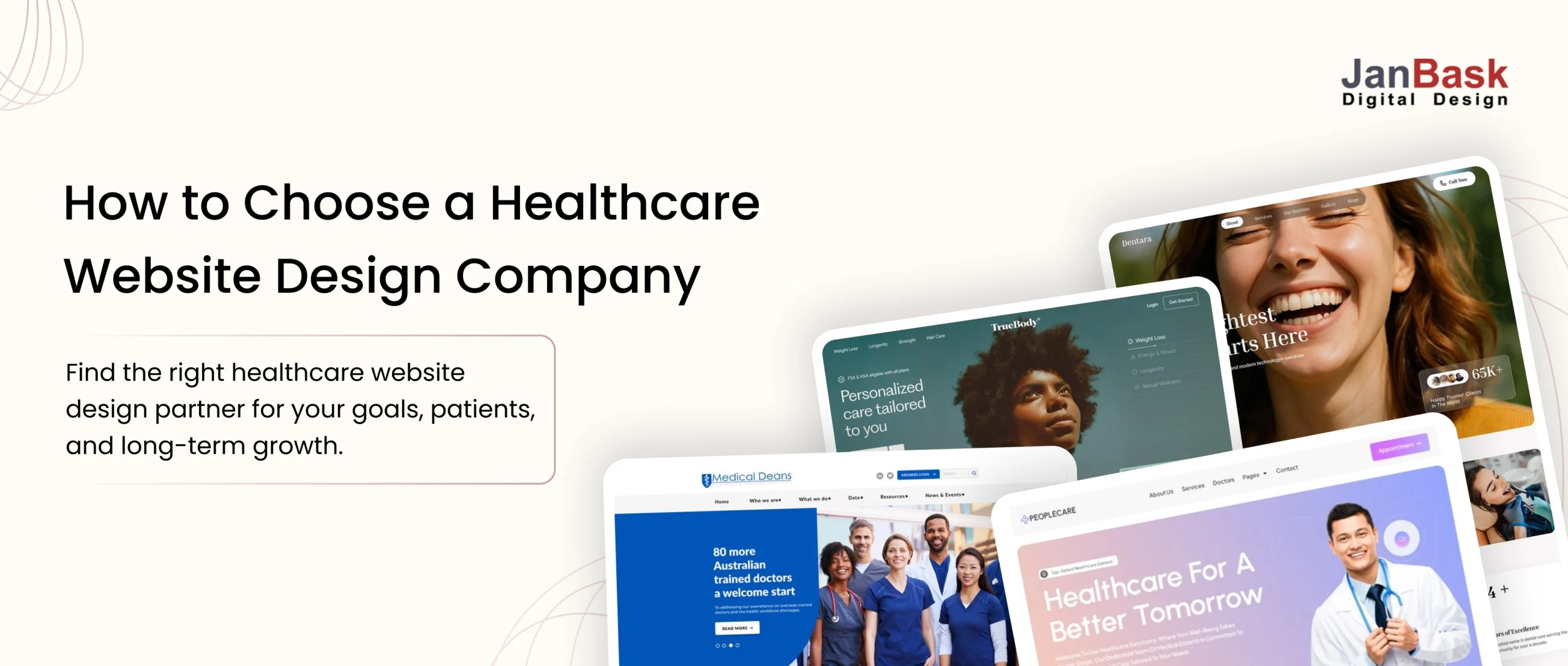
If you’ve started researching how to choose a healthcare website design company, you’ve probably noticed this is not like picking a designer for a restaurant or boutique. A healthcare website is often a patient’s first interaction with your practice, so it has to be reassuring, easy to navigate, and fast – and depending on what it collects and connects to, it may need privacy, accessibility, and security considerations a typical business site doesn’t. That’s why healthcare sites get held to a different bar, and the healthcare website design company you choose matters more than it would for a simpler project.
The good news: you don’t need to be a web design expert to choose well – just a clear framework. This guide covers how to choose a healthcare website design company: the requirements to define, the factors and criteria that matter, how to evaluate an agency against them, the questions to ask, and the red flags to watch for.
First Know What Your Healthcare Website Needs
Before you look at any agency’s portfolio, take a moment to think about your own healthcare website design requirements – what you want your website to do. These are some of the most important factors to consider when choosing a healthcare website design company, because they give you a clear way to assess whether an agency can actually meet your organization’s needs. Agencies will ask you this anyway. If you know the answer already, the whole process will go faster, and you’ll get better proposals.
-
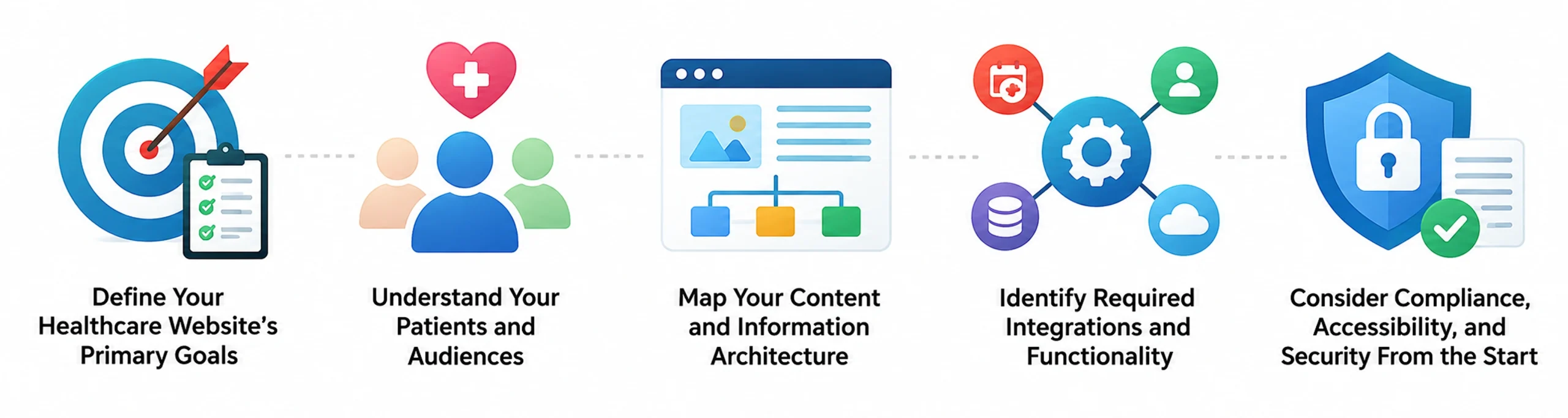
Define Your Healthcare Website’s Primary Goals
Start simply: what do you want this website to do? For some organizations, the priority is generating new patient appointments. For others, it’s reducing phone call volume by making information easier to self-serve. For a hospital system, it might be supporting multiple service lines, physician directories, and referral pathways all at once.
Write your goals down in order of priority. You don’t need a formal document – a short list is enough. This becomes your north star throughout the entire selection process, and it’s the first thing a strong agency will want to understand about you.
-
Understand Your Patients and Audiences
Your website exists for the people trying to find care, not for your internal team – but “the people trying to find care” is often a bigger group than just patients. Referring physicians may be looking for clinical credentials and referral pathways. Caregivers may be researching on someone else’s behalf. Job seekers may check out your careers page before applying. Think about the different paths each of these visitors might take – searching by symptom, by provider name, by insurance, or arriving through a referral link – since a site built with only one generic visitor in mind can end up frustrating everyone else who lands on it.
-
Map Your Content and Information Architecture
You don’t need a finished sitemap, but it helps to have a rough sense of what content your site needs to hold: how many providers, how many locations, how many service lines, and what kind of educational content you want to offer patients. If you already have content – provider bios, blog posts, patient resources – take stock of what exists and what will need to be created or reorganized.
This matters because information architecture (how content is organized and connected) has a direct effect on whether patients can actually find what they need, and it’s one of the first things a capable agency will assess during discovery. If you want a starting point, browsing a few well-designed healthcare websites can help you picture what good structure actually looks like.
-
Identify Required Integrations and Functionality
Many healthcare websites need to connect to other systems – an EHR or patient portal, online scheduling, a payment or billing platform, telehealth, or a CRM used by your marketing or intake team. Not every organization needs all of these, so it helps to make a simple list of what your site actually needs to talk to. Even a rough list will save time later and help agencies scope your project accurately.
-
Consider Compliance, Accessibility, and Security From the Start
It’s tempting to think of compliance and accessibility as things you’ll “handle later” – but for many healthcare organizations, they need to be part of the plan from day one. When a site collects, transmits, or handles PHI, HIPAA considerations affect form handling, analytics configuration, and third-party scripts – so it’s worth knowing early whether your site will touch PHI in any way (patient intake forms, secure messaging, portal integrations) or whether it stays purely informational.
Accessibility is a related but separate consideration. ADA is a legal framework that expects digital accessibility; WCAG (currently WCAG 2.2) is the technical standard most commonly used to meet it. This overview of ADA and WCAG requirements breaks down the difference in more detail. Either way, your site should be usable for patients relying on screen readers, keyboard navigation, or other assistive technology.
Security touches both of these – your hosting environment, how patient data moves through your forms, and how access to your CMS is controlled. You don’t need every answer yet. Just going in aware that these are foundational requirements, not add-ons, will change how you evaluate every agency you talk to.
What Makes a Healthcare Web Design Agency a Good Fit?
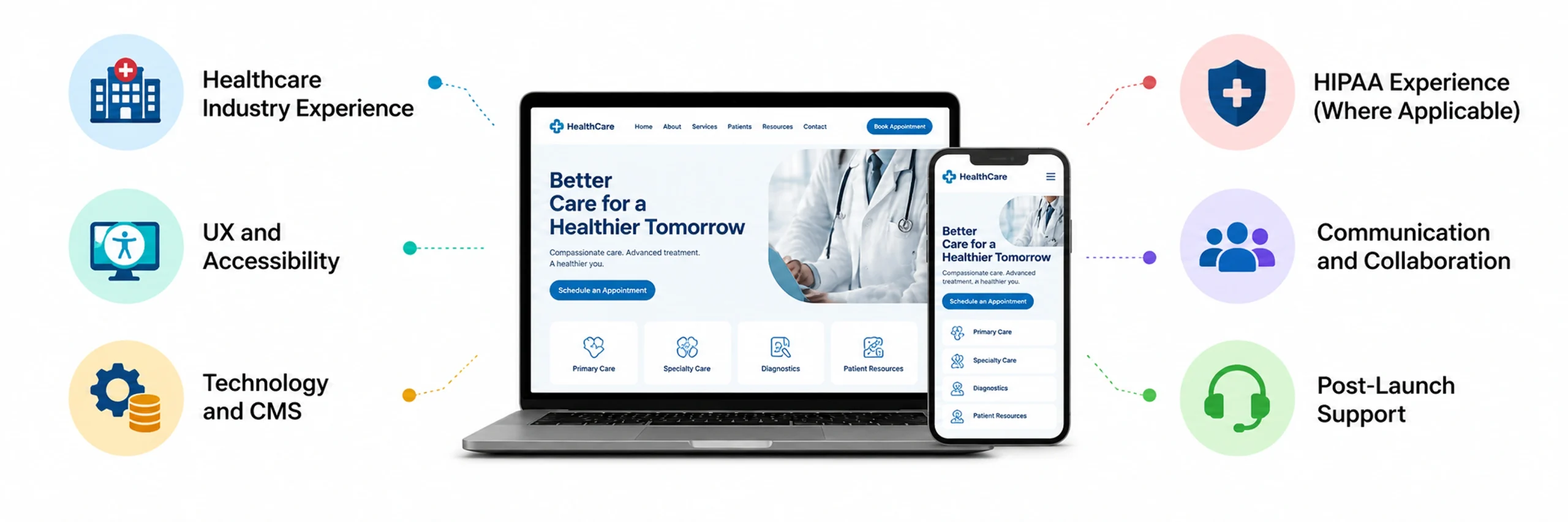 Once you know what your site needs to do, the next question is what to look for in a healthcare website design company. The following healthcare website design company selection criteria and best practices tend to separate agencies who understand healthcare from those who are simply comfortable working in any industry.
-
Healthcare Industry Experience
A polished portfolio tells you an agency can design a good-looking website. It doesn’t tell you whether they understand why a provider directory needs to filter by insurance and specialty, why appointment request forms need particular privacy handling, or why patients often behave differently than typical e-commerce shoppers.
When comparing healthcare website design agencies, look beyond visual quality and examine whether they demonstrate a practical understanding of healthcare-specific requirements. Healthcare experience tends to show up in the details – the questions an agency asks you, not just the sites they’ve already built.
-
UX and Accessibility
Patient-centered design accounts for people who may be stressed, in pain, or simply trying to get an answer quickly – that changes decisions about navigation, language, and form length. Look for an agency that treats accessibility as a standard part of that process, designing and testing against WCAG (currently WCAG 2.2) rather than adding it only when asked.
-
Technology and CMS
Ask what platforms and technologies they typically build on, and look for an agency that can explain those choices in terms of your goals – scalability, ease of content updates, integration flexibility – rather than defaulting to whatever they’re most comfortable with.
-
HIPAA Experience (Where Applicable)
If your site will collect, transmit, or handle PHI in any way – patient intake forms, secure messaging, portal integrations – look for an agency that can speak specifically about how they handle HIPAA considerations: form handling, analytics configuration, and third-party scripts. If your site stays purely informational, this matters less, but it’s still worth confirming they know the difference.
-
SEO and Content Strategy
Healthcare content isn’t like most website content – the words on your pages can directly influence someone’s health decisions, so accuracy and trustworthiness matter in a way a typical business website rarely has to consider. Look for an agency that treats content review as part of their process, not an afterthought, and that understands SEO for healthcare specifically – provider pages, service-line pages, and content that needs to be patient-friendly and search-optimized without sacrificing accuracy. If you have multiple locations, this should also extend to local SEO for healthcare providers, which is a different skill than general on-page optimization. This is one of the reasons general medical website development best practices look different from other industries.
-
Integration Experience
Look for an agency that’s comfortable working with the systems healthcare sites typically connect to – EHRs, scheduling platforms, telehealth tools, and patient portals. An agency without this experience may be technically capable but unfamiliar with the quirks and limitations of these systems, and that unfamiliarity often surfaces later in the project, when it’s more expensive to fix.
-
Performance and Security
A healthcare website needs to load quickly and hold up securely – page speed, backups, and access controls all matter more when patient trust, and in some cases PHI, are involved. Look for an agency that treats this as a baseline expectation, not an extra.
-
Communication and Collaboration
Look for a well-organized communication process – regular updates, clear points of contact, and a structured way of gathering your feedback. This is often a strong early indicator of how smoothly the rest of the project will go.
-
Post-Launch Support
Finally, look for an agency that thinks past launch day – one that can describe what ongoing maintenance, content support, or monitoring looks like, rather than treating the handoff as the finish line.
How to Evaluate a Healthcare Website Design Company
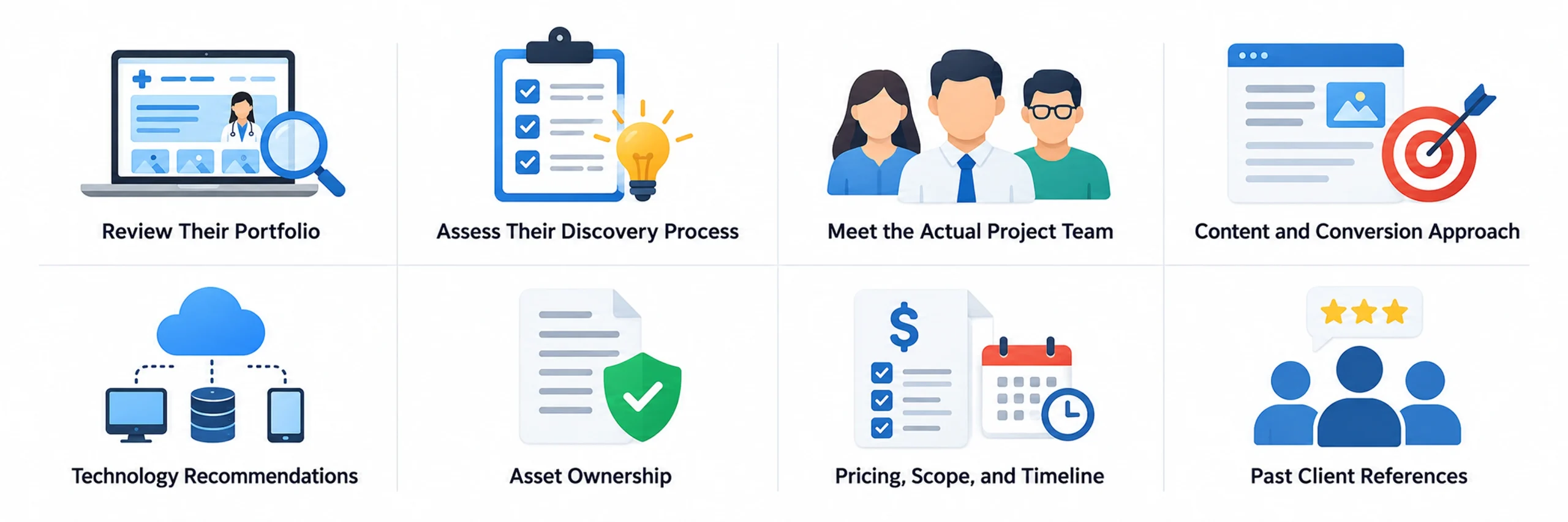
With a clear sense of what to look for, you’re ready to evaluate specific agencies. Knowing how to evaluate a healthcare website design company means turning those qualities from a wish list into something you can actually verify. The following actions give you a practical way to assess each agency before making a decision.
-
Review Their Portfolio
Look at actual healthcare websites they’ve built, not just general design work. Pay attention to navigation clarity, mobile responsiveness, and how easy it would be for a stressed or unfamiliar visitor to find what they need.
-
Assess Their Discovery Process
Ask what their discovery process looks like before design or development begins. A strong agency should have a structured way of learning about your goals, patients, and content – not a rush straight to visual design.
-
Meet the Actual Project Team
It’s common for a senior team to lead the sales conversation and a different, more junior team to execute the work. Ask directly who your day-to-day contacts and project team will be, and try to meet them before you sign.
-
Content and Conversion Approach
Ask how they’ll handle content strategy and how design decisions will tie back to your conversion goals – appointment requests, phone calls, or another action. Listen for specific examples, not general statements.
-
Technology Recommendations
Ask them to walk through their platform recommendation in the context of your specific needs, rather than a one-size-fits-all answer.
-
Asset Ownership
Confirm, in writing, who would own your domain, source code, CMS, hosting account, analytics access, and content once the project is complete. Some agencies build on proprietary systems or retain admin-level control by default, which can make it difficult – or expensive – to leave later.
-
Pricing, Scope, and Timeline
Ask for a clear breakdown of pricing, what’s included, what could increase cost, and a realistic timeline based on your project’s scope.
-
Past Client References
Ask for references from healthcare clients specifically, and don’t hesitate to reach out to them. A short conversation with a past client can tell you more than an hour of sales conversation ever could.
Questions to Ask Healthcare Website Design Company
Once you’ve narrowed your list, these are direct, testable versions of the criteria above – questions that can help you understand how to choose a healthcare web design company and get past the sales pitch to see how an agency will actually work with you.
-
How Do You Approach Discovery and Strategy?
Ask what their discovery process looks like before design or development begins. A strong agency should have a structured way of learning about your goals, patients, and content – not a rush straight to visual design.
-
Who Will Work on Our Project?
Ask directly who your day-to-day contacts and project team will be, and whether that differs from who you’ve been speaking with so far.
-
How Do You Make Design Decisions Around Patients?
Ask how they translate patient needs into actual design choices – navigation structure, content tone, form design, and accessibility decisions. Listen for specific examples, not general statements.
-
How Will You Approach Our Content and Conversion Goals?
Ask how they’ll handle content strategy and how design decisions will tie back to your conversion goals, whether that’s appointment requests, phone calls, or another action.
-
What Platform and Technology Would You Recommend-and Why?
Ask them to walk through their platform recommendation in the context of your specific needs, not as a one-size-fits-all answer.
-
How Will You Handle Our Healthcare Integrations?
If you identified required integrations earlier, ask specifically how they’ve handled similar integrations before, and what challenges to expect.
-
What Happens to Our Assets and Ownership If We Ever Part Ways?
Ask what happens to your domain, hosting, code, and content if you ever switch agencies or bring work in-house – and get this in writing, not just as a verbal assurance.
-
What Are Your Pricing, Timeline, and Project Assumptions?
Ask for a clear breakdown of pricing, what’s included, what could increase cost, and a realistic timeline based on your project’s scope.

Red Flags That Should Make You Pause

As you go through conversations and proposals, a few warning signs are worth taking seriously.
-
No Relevant Healthcare Portfolio
If an agency can’t show you healthcare-specific work, that’s worth pausing on. General design skill doesn’t automatically translate to healthcare-specific understanding.
-
Unclear Answers About HIPAA (When It Applies)
If your project involves PHI in any way and an agency can’t speak specifically about how they handle it, that’s worth taking seriously. If your project doesn’t involve PHI, this matters less – but an agency that assumes every healthcare site is automatically PHI-heavy, or dismisses the question entirely, hasn’t fully thought it through either.
-
Accessibility Treated as an Afterthought
If accessibility only comes up when you ask about it, rather than being part of their standard process, that’s a meaningful gap.
-
Vague Answers About Technology
If an agency can’t clearly explain their technology recommendations or how they’ll handle your integrations, that uncertainty tends to carry into the project itself.
-
No Real Discovery Process
If an agency moves straight to design or pricing without asking about your goals, patients, or content, they’re likely applying a generic template rather than a plan built around your organization.
-
Unclear Project Team
If you can’t get a straight answer about who will actually work on your project, be cautious – this often signals inconsistent quality or availability issues down the line.
-
Unrealistic Promises
Be wary of agencies that make big promises about results or timelines without being able to describe the actual process that gets you there.
-
Low Quote With No Defined Scope
A very low quote offered without a clear scope or discovery process is a sign the agency hasn’t actually assessed your project – which usually means surprises later.
How to Compare Your Shortlisted Agencies
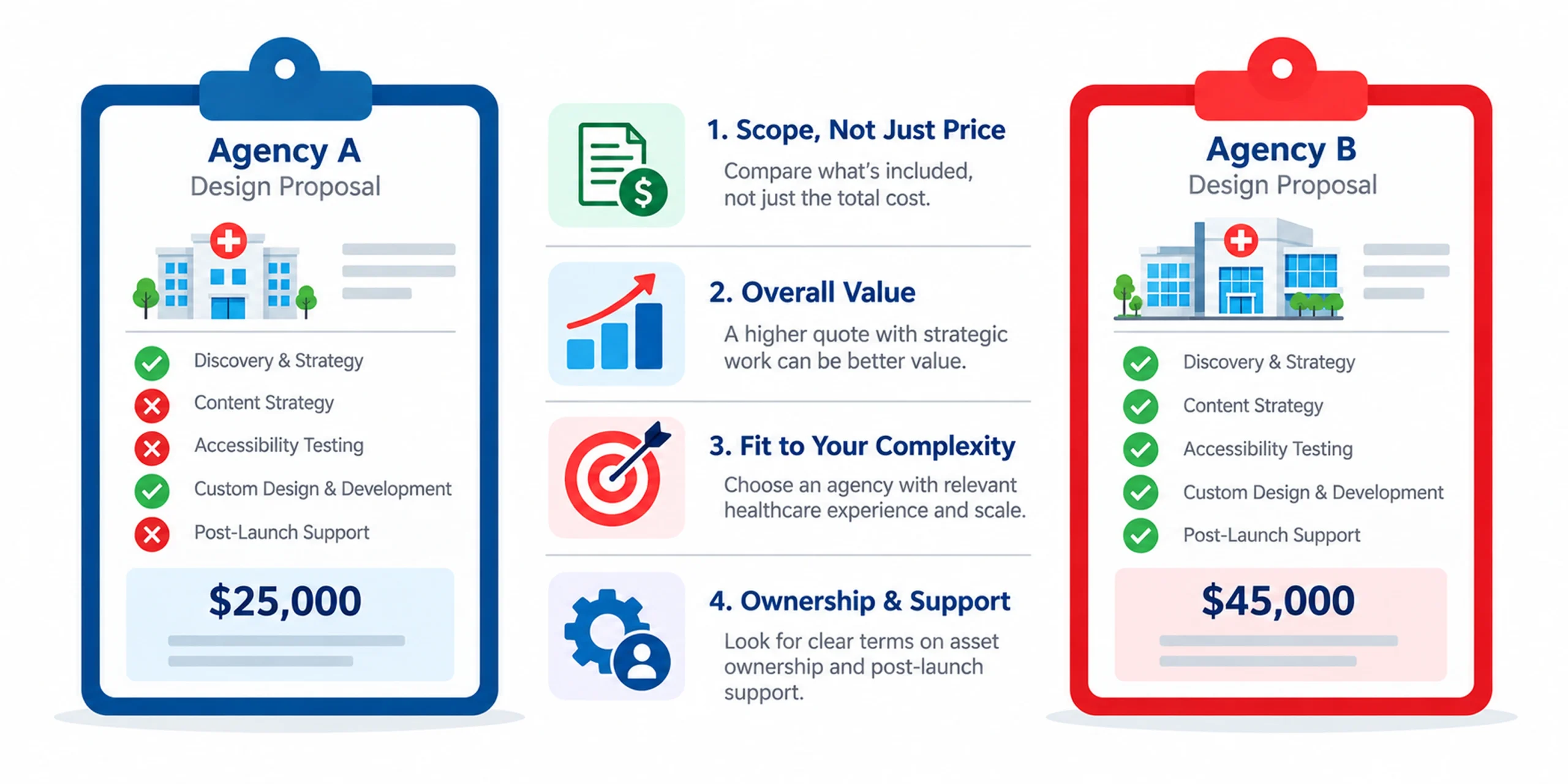
Once you’ve gathered proposals, it’s tempting to line them up by price alone. Instead, use the healthcare website design company selection criteria you’ve established to compare scope, experience, technology, ownership, and ongoing support. Fit matters more than the number at the bottom of the quote.
-
Weigh Scope, Not Just Price
Compare what’s actually included in each proposal – discovery, content strategy, accessibility testing, post-launch support – rather than the total number by itself. A low number attached to a thin scope isn’t actually a better deal.
-
Look at Overall Value
A higher quote that includes real strategic work is often better value than a lower one that leaves gaps you’ll have to fill yourself. It can help to first understand what a healthcare website actually costs so you can tell a lean quote from an underscoped one, and to weigh whether hiring a professional web design agency is worth it against a freelancer for a project of your scope.
-
Match Fit to Your Organization’s Complexity
A single-provider practice and a multi-location hospital system have very different needs. Make sure the agency you choose has experience at a scale and complexity similar to yours – not too small to keep up, and not so large that your project becomes a low priority.
-
Compare Ownership and Support Terms
Don’t let ownership and support terms get lost in the price comparison. Weigh how clearly each agency answered your questions about asset ownership and post-launch support – an agency that’s vague here can end up costing you more down the line than one with a slightly higher quote.
What Happens After Your Website Goes Live?
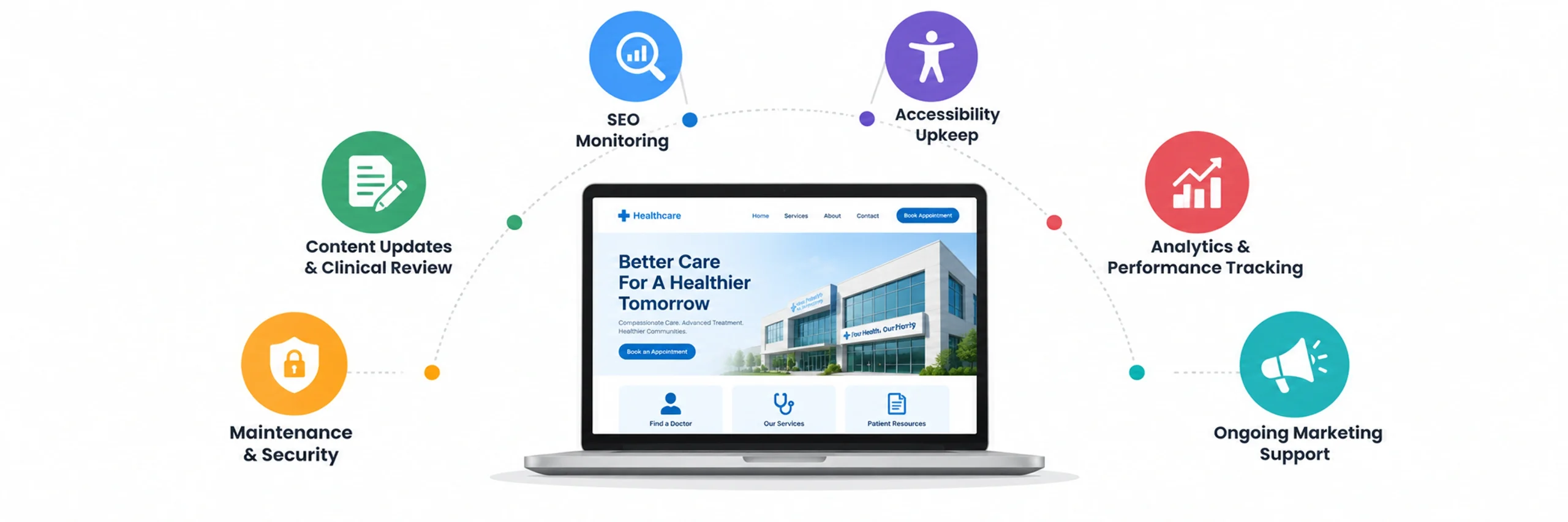
A website project doesn’t really end at launch. If you’re replacing an existing site, this is also the moment your SEO is most at risk – ask how the agency plans to protect it, through proper redirects, preserved metadata, an updated sitemap, and continuity in tools like Google Search Console, before anything goes live. Once the new site is up, a few things determine whether it keeps working for you.
-
Maintenance and Security
Ask how the agency approaches page speed, backups, and access controls, and what routine maintenance is included versus billed separately. A healthcare website maintenance checklist is a useful reference for what this should typically cover.
-
Content Updates and Clinical Review
Ask who’s responsible for content after launch – who writes new pages, who reviews clinical claims for accuracy, and how updates get made when a provider leaves or a service changes.
-
SEO Monitoring
Rankings and organic traffic should be tracked on an ongoing basis, not just checked once after launch. Ask how the agency, or your internal team, will monitor performance and catch issues early.
-
Accessibility Upkeep
Accessibility isn’t a one-time fix – new pages, forms, and content can introduce new issues over time. Ask how accessibility gets checked as the site evolves, not just at launch.
-
Analytics and Performance Tracking
Confirm you’ll retain access to your own analytics, and that someone is watching the numbers that matter to your goals – appointment requests, calls, and form completions.
-
Deciding on Ongoing Marketing Support
Some organizations want the same team handling both the website and ongoing healthcare digital marketing – SEO, content, and performance tracking. Others prefer to keep those separate. There’s no universally right answer, but it’s worth deciding intentionally rather than assuming it will get handled by default.
Your Final Checklist Before You Decide
Before you sign anything, do one last pass through the key factors to consider when choosing a healthcare website design company:
- Have you clearly defined your website goals, patients, and audiences?
- Does the agency have a relevant, verifiable healthcare track record?
- Have they given clear, specific answers about PHI, HIPAA, and accessibility where applicable?
- Do you understand exactly who will work on your project?
- Have you confirmed who owns your domain, code, and content after launch?
- If you’re migrating from an existing site, have you discussed a redirect and SEO continuity plan?
- Is the scope clearly defined, with pricing and timeline tied to it?
- Have you confirmed what post-launch support is included, and what costs extra?
- Have you spoken with at least one past healthcare client?
- Do you feel confident in their process, not just their portfolio?
If you can answer yes to most of the items above, you’re in a strong position to move forward – with a partner who understands not just how to build a website, but how to build one that actually serves your patients and your practice. And if this decision was prompted by an existing site that’s falling short, our healthcare website redesign checklist is a good next stop.
You don’t have to work through every stage of this alone. If it’s more than your team has bandwidth for, this is exactly the kind of work we do at JanBask Digital Design– from discovery through post-launch support, building healthcare website design experiences around patient-centered design, accessibility, and HIPAA-conscious development.