

Every year you delay a redesign, a patient chooses your competitor instead and you never even find out why. Maybe the booking form had too many steps and the patient gave up halfway through. Maybe the site took too long to load on their phone in a waiting room. Maybe a patient searched for you and found a competitor’s site first.
None of that shows up as a complaint. It shows up as a patient who never called someone who quietly left for a practice whose site felt easier to trust. That’s the real cost of treating this as a maintenance problem: a fresh photo or a plugin update fixes what’s visibly broken, but it doesn’t fix a site that was never built around how patients actually search, decide, and book.
This healthcare website redesign checklist exists to catch that gap before it costs you another patient. Whether you’re calling it a healthcare or medical website redesign checklist, what follows is the same: the order to work through so nothing slips through a crack you didn’t know was there.
Do You Actually Need a Redesign? Here’s How to Tell
Not every website problem needs a full rebuild. Sometimes you need a redesign; sometimes you need a few fixes. Here’s how to know which one you’re facing:
- Slow. If your site takes more than three seconds to load, patients are gone before they even see what you offer.
- Outdated content. Stale bios, old stats, and services you no longer provide are still sitting live on the site.
- Poor mobile UX. Most patients are searching from a phone if the site wasn’t built mobile-first, they’re fighting it the whole way through.
- Low conversions. Traffic is showing up, but it isn’t turning into booked appointments.
- Accessibility gaps. Beyond the legal risk, gaps like these quietly shut out patients who can’t use the site at all.
- Difficult booking. If scheduling takes too many steps or asks for information patients don’t have handy, they close the tab.
- Poor search visibility. If you’re not showing up for the searches patients actually run, none of the rest matters.
If two or three of these hit close to home, you’re in redesign territory, not just a tweak-it-and-move-on situation. If all five hit, keep reading, because the rest of this checklist is exactly what you need.
Audit Before Plan Your Healthcare Website Redesign
This is step one for your healthcare website redesign checklist. You wouldn’t renovate a house without knowing which walls are load-bearing and the same logic applies here. Good healthcare website redesign planning means knowing which pages are already working before you touch a single design file.
Start here:
- Pull your analytics and search console data. Which pages bring in traffic, and which ones just sit there?
- List every URL on your site – service pages, provider bios, old microsites – and mark each one Keep, Rewrite, Merge, or Delete.
- Walk through the site the way a patient would, not the way your internal team navigates it.
- Ask your front-desk and call-center staff what patients keep asking. That list is your new FAQ page.
Skip this step and you’re not redesigning you’re just guessing with a bigger budget.
Set Your Website Redesign KPIs
Before you design a single page, decide what success actually looks like. Set baseline numbers now – bookings, portal signups, bounce rate, page speed – so once the new site is live, you’re measuring real impact against something concrete, not just judging it on looks.
Redesign Your Healthcare website Around the Patient Journey
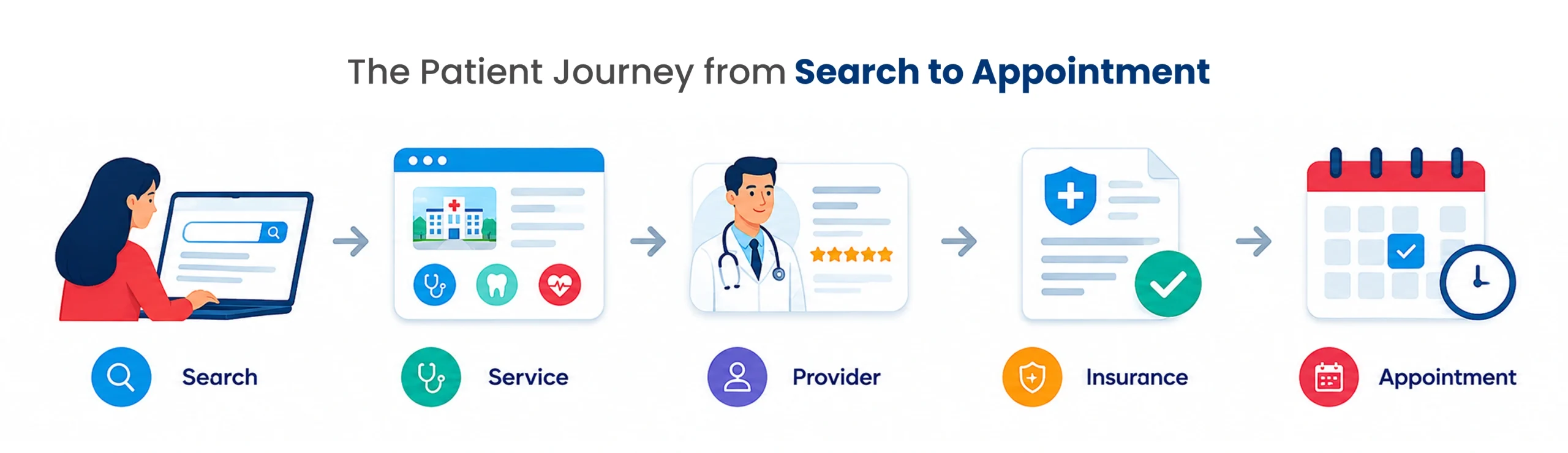
Nobody lands on your site, reads one page, and books. Patients stitch together a journey search results, a provider bio, a service page, and eventually a form. Google’s own healthcare research has consistently found that patients research extensively across multiple provider sites before ever picking up the phone.
That journey usually runs in one direction: search → service → provider → insurance → appointment. Map yours the same way, and remember it isn’t always the patient making the trip – a caregiver booking on someone else’s behalf follows a slightly different path and needs it to be just as clear.
So make that journey easy to follow:
- Put patient portal and appointment booking in your primary navigation – not three clicks deep.
- Add a search bar that actually works, with shortcuts to your highest-intent pages.
- Use CTAs (call-to-action) that ask for the action you want (“Schedule Your Consultation,” not “Learn More”).
- Give every provider a consistent bio template: credentials, specialties, accepted insurance, and a direct booking link.
Plan Your Navigation First
It’s tempting to start with the homepage; it’s the page everyone has an opinion on. But if navigation is confusing, a beautiful homepage just means more people get lost one click later. Fix how people move through the site before you touch how it looks.
What Makes a Patient Trust Your Site in the First Few Seconds?

stress at exactly the moment your visitor needs that.
Stay consistent everywhere. The same colors, fonts, and photography style across every single page send an unspoken signal: this organization is careful and well-run – see it in action across these 20 best healthcare websites that get this right. It’s the digital version of walking into a spotless, organized waiting room.
Say what you do, not how you feel about it. “Compassionate, world-class care” tells a patient nothing. A specific number, outcome, or accreditation does.
The sections above cover the healthcare website redesign best practices that consistently earn that trust.
Make Accessibility and Compliance Part of the Website Redesign
This is the phase most teams treat as an afterthought, and it’s the one with the sharpest consequences – both human and legal.
Digital accessibility lawsuits aren’t slowing down. UsableNet’s year-end tracking shows more than 5,000 digital accessibility lawsuits were filed in 2025 alone, and litigation has been steadily broadening beyond retail into healthcare, financial services, and hospitality.Retrofitting accessibility after launch almost always means compromising on usability or blowing your timeline – build it in from your first wireframe instead.
Ask yourself:
- Does every template – not just the homepage – meet WCAG 2.1/2.2 AA standards?
- Is every patient intake form built with HIPAA-compliant handling in mind — and is your privacy policy written in plain language, not legal jargon?
- Can users adjust text size, contrast, and spacing if they need to?
- Do you offer multilingual support if part of your patient population doesn’t speak English as a first language?
Plan the Content Before the Redesign
Content almost always gets treated as an afterthought, something to “fill in” once the templates are done. Flip that order, and the redesign gets easier, not harder.
- Start with a full content inventory: every provider bio, service page, FAQ, and location page currently live.
- Have a medical reviewer check clinical content for accuracy before it’s rewritten, not after.
- Update metadata (title tags, meta descriptions) alongside the content itself, not as a separate pass.
- Assign a content owner for each page type before launch, so nothing goes stale the moment the new site goes live.
Make Performance a Redesign Requirement
None of the above matters if your site is slow. Google’s own research on mobile behavior found that 53% of mobile visits are abandoned once a page takes longer than three seconds to load.Healthcare sites – loaded with provider directories, scheduling widgets, and high-resolution images – are especially prone to this kind of bloat.
Run these checks before you call the redesign done:
- Test Core Web Vitals (LCP, INP, CLS) with PageSpeed Insights and fix anything render-blocking — our website speed optimization guide covers the full process.
- Compress images and serve them in WebP format.
- Test on a real mid-range phone on a slow connection — not just your developer’s laptop on office Wi-Fi.
- Check that third-party scheduling widgets and embedded forms don’t quietly drag load times down.
- Set up monitoring for broken links and redirect chains before and after launch.
Protect and Grow Your SEO During the Redesign
A beautifully designed site nobody finds is just an expensive brochure. Build your content around how patients actually search, not around your internal department names.
- Write one keyword-mapped title tag (50–60 characters) and meta description (120–160 characters) per URL, with exactly one H1 per page.
- Map every old URL to its new equivalent and set up redirects before launch — losing rankings mid-redesign is one of the most common (and avoidable) mistakes. Our website redesign SEO checklist walks through this step by step.
- Lead every section with a direct answer before expanding into detail — this helps both skimming readers and AI search summaries.
- Add FAQ or How-To schema, descriptive internal links, and alt text on every meaningful image.
- Update your sitemap and confirm every important page is indexable, not accidentally blocked.
- Include a medical-reviewer byline on clinical content, and fact-check any AI-assisted draft before it goes live.
Test the Website Like a Patient Before Launch
This is the step most redesigns skip and it’s the one that catches what QA checklists miss. Before launch, run real tasks the way an actual patient would:
- “Find a dermatologist.”
- “Check whether they accept my insurance.”
- “Book an appointment.”
- “Find the patient portal.”
- “Find the clinic’s phone number.”
A lot of healthcare web redesign checklist guides stop at design and speed; they skip this step entirely, even though it’s the one that catches what real users actually run into.
Launch Without Losing What Already Works
A redesign that quietly tanks your rankings or breaks your tracking isn’t a launch, it’s a setback. Our website redesign SEO guide covers this relaunch stage in more depth, but before you flip the switch, confirm:
- Your redirect map is complete and tested.
- Metadata and content have fully migrated — nothing reverted to a template default.
- Analytics and Search Console are reconnected and verified.
- Every form and integration (scheduling, chat, payments) still works end to end.
- Tracking and conversion goals fire correctly on the new site.
- You have a full backup, and a final QA and monitoring pass before going live.
Treat Post-Launch as Part of the Redesign
The single biggest predictor of whether your redesign holds up two years from now isn’t the design. It’s whether anyone actually owns it after launch.
- Assign a content owner and a review schedule before you launch, not after.
- Set baseline KPIs – bookings, portal signups, bounce rate, page speed – so you can measure real impact, not just how it looks.
- Run quarterly content and technical audits to catch outdated stats, broken forms, and accessibility drift. For a full breakdown, see the healthcare website maintenance checklist.
- Refresh your most-overlooked pages first. Careers, “About Us,” and physician bios are consistently the least maintained and the most visited.
Healthcare Website Redesign Mistakes to Avoid
- Redesigning before auditing what’s already working.
- Letting stakeholder opinion override patient data when deciding what stays on the new site.
- Treating the homepage as the entire user experience.
- Leaning on generic differentiator copy (“personalized care,” “world-class physicians”) that any competitor could also claim.
- Treating accessibility as a final QA pass instead of a design constraint from day one.
- Starting content writing after the design is already locked, which forces rushed copy around finished templates.
- Ignoring how the site performs on mobile until it’s already live.
- Forgetting to map redirects and migrate SEO equity during the move.
- Launching without testing real patient tasks end to end.
- Launching and walking away — content decays fast without someone owning it.
Most of these mistakes come down to one thing: redesigning without a strategy. Our website redesign strategy guide walks through the planning steps that prevent this list from happening in the first place.
The Ultimate Healthcare Website Redesign Checklist
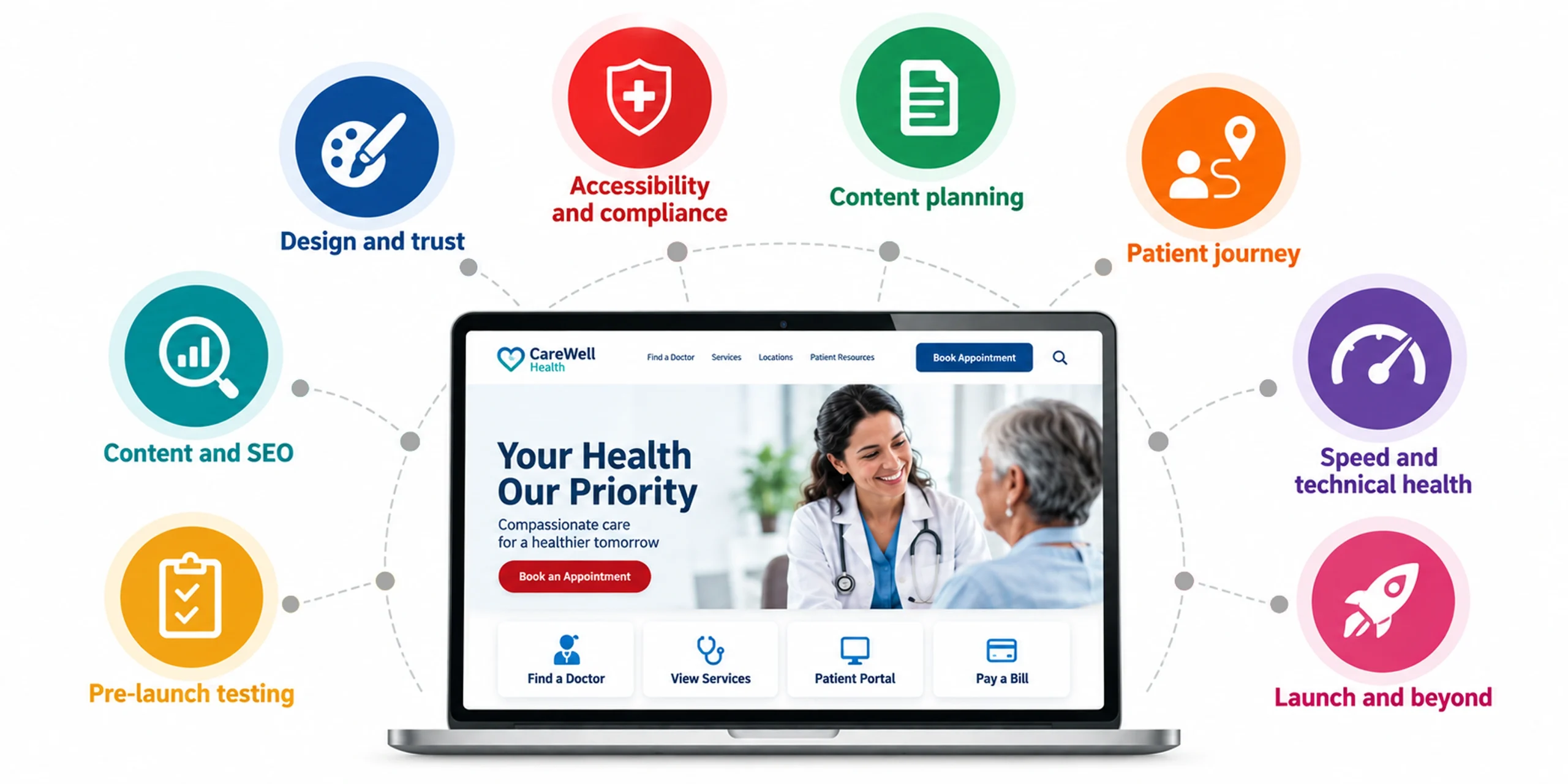
This is every phase of the healthcare website redesign process condensed into one list.
Before you start
- Pull analytics and mark every URL Keep, Rewrite, Merge, or Delete
- Interview front-desk and call-center staff for common patient questions
- Map the journey for every audience your site serves — patients, caregivers, referring providers
- Set baseline KPIs before design begins
Design and trust
- Replace stock photography with real staff and facility images.
- Standardize colors, fonts, and photography style which is the UX design idea.
- Rewrite navigation labels into plain language.
Accessibility and compliance
- Test every template against WCAG 2.1/2.2 AA
- Confirm HIPAA-appropriate handling on every form
- Add adjustable text size and contrast controls
Content planning
- Complete a full content inventory before design starts
- Assign a medical reviewer for clinical content
- Assign content ownership by page type
Patient journey
- Put booking and portal access in the primary navigation
- Standardize provider bio templates
- Use action-oriented CTAs throughout
Speed and technical health
- Test Core Web Vitals and fix render-blocking scripts
- Compress and serve images in WebP
- Test on a real mid-range phone, not just a desktop
Content and SEO
- Write unique title tags and meta descriptions per URL.
- Add FAQ/How-To schema and alt text sitewide — see the full SEO for healthcare websites guide.
- Add a medical-reviewer byline on clinical content.
- Map redirects for every existing URL
Pre-launch testing
- Run real patient tasks end to end
- Test forms, booking, and accessibility together
Launch and beyond
- Confirm redirect map, analytics, and integrations before go-live
- Assign a content owner and review cadence
- Schedule your 30-, 60-, and 90-day post-launch reviews
Where This Leaves You
A good redesign isn’t seven separate projects. It’s one decision, made seven times: does this choice serve the person on the other end of the screen, or the people in the room?
Start with an audit of what’s working. Design for trust before polish. Build accessibility into your wireframes, not your QA checklist. Structure the journey around booking and portal access, not buried menus. Make speed non-negotiable. Write content that both search engines and stressed-out humans can parse in five seconds. And then – the part almost everyone skips – assigns someone to own the site after launch, because a site nobody maintains starts decaying the day it goes live.
That’s the full healthcare website redesign checklist the rest comes down to execution. You don’t have to run every phase alone, though. If it’s more than your team has time for, this is exactly the kind of work we do at JanBask, from the first audit through post-launch maintenance — building healthcare website redesigns that are planned with the same care this checklist walks through, not just designed.